Binance Profit and Loss Calculator – Calculate Crypto Trading Profit
Binance
Crypto Profit/Loss Calculator
Result will appear here!
The Complete Guide to Calculating Binance Profit and Loss
What Is a Binance Profit and Loss Calculator?
A Binance profit and loss calculator is an online tool that helps crypto traders find out exactly how much money they made or lost on a trade. You enter your buy price, sell price, the amount of crypto you traded, and the trading fees — and the tool instantly shows your gross profit, total fees, net profit or loss, ROI percentage, and break-even price.
Most traders assume they know their profit just by looking at price movement. But that is rarely the full picture. The actual profit from any trade depends on three things working together: the price difference, the position size, and the fees paid on both sides of the trade. Miss any one of these and your calculation is wrong.
A dedicated crypto profit calculator handles all three automatically, which is why serious traders use one before entering and after exiting every position.
Why Crypto Traders Need a Profit Calculator
The crypto market moves faster than any other financial market in the world. Prices can shift 5% in minutes, leverage amplifies both gains and losses, and trading fees quietly eat into every single position you open. Without a reliable way to calculate your true profit, you are essentially guessing — and guessing in crypto is expensive.
Here is the core problem: most traders calculate profit by subtracting buy price from sell price and multiplying by quantity. This gives you gross profit. But gross profit is not what hits your wallet. What hits your wallet is gross profit minus the fee you paid when you bought, minus the fee you paid when you sold. On high-frequency trades or leveraged positions, the gap between gross and net profit can be surprisingly large.
Beyond fees, a profit calculator helps you answer questions that matter before a trade happens. What price does Bitcoin need to reach for me to make $500 on this position? How large does my position need to be to hit a 10% return? What is my exact break-even price after fees? These are not questions you want to solve in your head while watching a chart move in real time.
How Profit Calculation Works in Crypto Trading
Every crypto trade has two sides: entry and exit. When you buy, you spend money and pay a fee. When you sell, you receive money and pay another fee. The difference between what you received and what you spent — including both fees — is your net profit or loss.
The percentage return is then calculated by dividing that net profit by your original investment and multiplying by 100. This percentage, known as return on investment or ROI, is the most useful way to compare trades of different sizes against each other.
What makes crypto profit and loss calculation slightly more complex than stock trading is the fee structure. Binance charges different fees depending on your account tier, whether you are trading spot or futures, and whether you pay fees with BNB. Understanding these variables is essential for accurate calculation, which is why the next section walks through each one in detail.
How to Use the Binance Profit and Loss Calculator
Using a Binance profit and loss calculator takes less than a minute once you understand what each field is asking for. Here is exactly what to enter and why each input matters.
Step 1 – Enter Buy Price
The buy price is the price per coin at which you purchased the cryptocurrency. Always use the exact price from your Binance order history rather than an approximate figure. Even a small rounding difference can materially change your profit and loss calculation on large positions. For limit orders, use the filled price — not the price you set the limit at, since partial fills can result in a slightly different average entry price.
Step 2 – Enter Sell Price
The sell price is the price at which you exited or plan to exit the trade. If you are calculating the profit and loss on a completed trade, use your exact exit price from order history. If you are planning a future trade, enter your target take-profit price. This lets you see your potential profit before you ever place the order — which is how disciplined traders approach every setup.
Step 3 – Enter Trade Amount
Trade amount refers to the quantity of coins involved in the trade. Some calculators also allow you to enter the total investment value in USDT and calculate the coin quantity automatically using the buy price. Either method works. What matters is accuracy — using the precise number of coins or the exact dollar amount you invested, not a rough estimate.
Step 4 – Add Trading Fees
This is the step most traders skip, and it is the most important one. Binance charges a percentage-based fee on both the buy side and the sell side of every trade. The standard spot trading fee is 0.1% per transaction. If you hold BNB in your account and enable the option to pay fees with BNB, that rate drops to 0.075%. Higher-volume traders on VIP tiers pay even lower rates.
For futures trading, the standard maker fee is 0.02% and the taker fee is 0.05%. If your trade involved holding a futures position overnight or longer, you also need to account for funding rates — periodic payments between long and short position holders that can add meaningful cost to extended positions.
Enter the correct fee percentage for your account. If you are unsure, log into Binance, go to your fee rate page under account settings, and use the exact figure shown there.
Step 5 – Calculate Profit or Loss
Once all fields are filled in, the calculator returns your results instantly: gross profit before fees, total fees paid across both sides of the trade, net profit or loss in dollar terms, your ROI as a percentage, and your break-even price — the exact sell price at which you would have neither made nor lost money after fees.
Review all five outputs, not just the profit figure. The break-even price in particular is underused but highly valuable — it tells you the minimum price your exit needs to reach just to cover your costs.
Crypto Profit Calculation Formula Explained
Understanding the formula behind the calculator makes you a more informed trader. It also lets you spot errors quickly if a result looks wrong.
Profit Calculation Formula
The calculation follows a straightforward sequence:
Gross Profit = (Sell Price − Buy Price) × Quantity
Buy Fee = Buy Price × Quantity × Fee Rate
Sell Fee = Sell Price × Quantity × Fee Rate
Net Profit or Loss = Gross Profit − Buy Fee − Sell Fee
ROI Percentage = (Net Profit ÷ Total Investment) × 100
Break-Even Price = Buy Price × (1 + Fee Rate) ÷ (1 − Fee Rate)
The break-even formula is especially useful. It accounts for the fact that you paid a fee when buying, so the sell price needs to exceed the buy price by more than just the fee percentage — it needs to cover the compounding effect of fees on both sides.
Example Bitcoin Trade Calculation
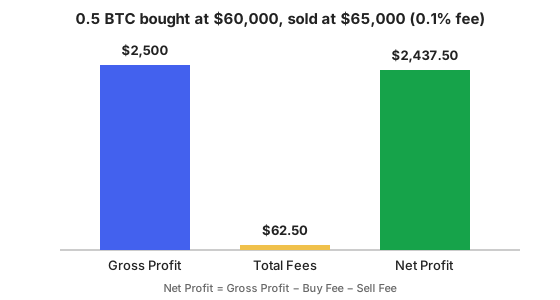
Suppose you bought 0.5 BTC at $60,000 and sold at $65,000, with a standard 0.1% fee on both sides.
Total investment: 0.5 × $60,000 = $30,000
Total sale value: 0.5 × $65,000 = $32,500
Buy fee: $30,000 × 0.001 = $30.00
Sell fee: $32,500 × 0.001 = $32.50
Total fees: $62.50
Net profit: $2,500 − $62.50 = $2,437.50
ROI: ($2,437.50 ÷ $30,000) × 100 = 8.125%
Without accounting for fees, you would have calculated an 8.33% return. The difference seems small on a single trade, but across 50 trades per month it adds up to hundreds of dollars in miscalculated profit.
Example Ethereum Trade Calculation
Now consider a losing trade: you bought 5 ETH at $3,200 and sold at $2,900, paying the BNB-discounted fee of 0.075% on both sides.
Total investment: 5 × $3,200 = $16,000
Total sale value: 5 × $2,900 = $14,500
Gross loss: $14,500 − $16,000 = −$1,500
Buy fee: $16,000 × 0.00075 = $12.00
Sell fee: $14,500 × 0.00075 = $10.875
Net loss: −$1,500 − $12 − $10.875 = −$1,522.875
ROI: (−$1,522.875 ÷ $16,000) × 100 = −9.52%
The fees added $22.875 to the loss — a figure that matters, especially if you are tracking performance over dozens of trades and trying to understand your true edge.
Understanding Binance Trading Fees
Binance operates one of the most competitive fee structures in the industry, but the details matter. Using the wrong fee rate in your calculations will give you inaccurate results every time.
Spot Trading Fees
The base fee for spot trading on Binance is 0.1% for both maker and taker orders at the VIP 0 level — meaning accounts with less than $1 million in 30-day trading volume. Enabling BNB fee payment reduces this to 0.075%.
As your trading volume increases, your account moves up through VIP tiers. VIP 1 accounts, with at least $250,000 in monthly volume (or 25 BNB held), pay 0.09% maker and 0.1% taker. Fees continue to drop at higher tiers, and the highest tiers pay a small fraction of a percent — though reaching them requires very large monthly volume.
Most retail traders are on VIP 0. If you hold and use BNB for fee payment, your effective rate is 0.075% — use this figure in your calculator inputs for the most accurate results.
Futures Trading Fees
Binance Futures uses a separate fee schedule designed for the different mechanics of leveraged trading. For USDT-margined futures at VIP 0, the maker fee is 0.02% and the taker fee is 0.05%. Coin-margined futures have slightly different rates.
The key distinction in futures is between maker and taker orders. A maker order is a limit order that does not immediately fill — it sits in the order book and adds liquidity. A taker order fills immediately against existing orders, removing liquidity. Taker orders always cost more. If you trade futures primarily with market orders, always use the taker fee rate in your calculations.
How Fees Affect Profit
Consider what fees actually cost at a practical trading frequency. If you make 20 round-trip spot trades per month at an average position size of $5,000 with a 0.1% fee on each side, your monthly fee bill is $200. That is $2,400 per year paid purely in trading costs — before a single losing trade.
At that fee level, you need to generate more than $200 per month in gross profit just to break even. Strategies that rely on small, frequent gains — sometimes called scalping — are particularly vulnerable to fee drag. A trader scalping for 0.3% per trade while paying 0.2% in round-trip fees has a real edge of only 0.1%, which a single losing trade can eliminate entirely.
This is why inputting the correct fee rate into your profit calculator is not optional. It is the foundation of every honest trade evaluation. Fee schedules do change over time, so it's worth double-checking your exact rate on Binance's own fee page periodically rather than assuming last year's numbers still apply.
Benefits of Using a Crypto Profit Calculator
Accurate Calculations
Manual calculation of crypto profit and loss is prone to error. Most traders either forget to subtract fees, use the wrong fee rate, or make arithmetic mistakes when working across multiple decimal places. A calculator eliminates all of these sources of error and delivers the same accurate result every time, regardless of how complex the position is.
Faster Trade Decisions
In volatile markets, speed matters. Being able to punch in your entry, exit, and position size and get an instant result means you can evaluate a trade setup in seconds rather than minutes. This speed is especially valuable when markets are moving and opportunities are closing fast.
Risk Management
The single most powerful use of a profit and loss calculator is pre-trade risk analysis. Before you enter any position, calculate the dollar loss if your stop-loss is triggered. If that number is larger than you are comfortable with, reduce your position size. This discipline — running the downside calculation before every trade — is the hallmark of traders who survive long-term in crypto markets.
Common Mistakes Crypto Traders Make
Ignoring Trading Fees
This is the most widespread and costly mistake in retail crypto trading. A 0.1% fee feels negligible in isolation, but it applies to the full value of your position on every entry and every exit. On leveraged positions, where your position size is many times your actual capital, fees can consume your margin before price even moves against you in a meaningful way. Never calculate profit without including fees on both sides.
Overtrading
The psychological pull toward constant activity is one of the most dangerous forces in trading. More trades mean more fees, more exposure to market noise, and more opportunities to make impulsive decisions. Many retail traders who believe they have a profitable strategy are actually running a losing one when fees are properly accounted for. Use the calculator to stress-test your strategy: if your average gain per trade barely exceeds your round-trip fee cost, your edge is either very thin or nonexistent.
Emotional Trading
Fear and greed are not abstract concepts — they show up in concrete, measurable ways. Fear causes early exits that realize smaller gains than planned. Greed causes traders to hold losing positions far beyond their original stop-loss level, hoping for a reversal. Both behaviors are best countered not by willpower but by pre-commitment: calculate your target profit and your maximum acceptable loss before the trade, write them down, and treat those numbers as binding. The calculator makes this process concrete and fast.
Tips to Maximize Crypto Trading Profits
Use Stop Loss
Every trade should have a stop-loss level defined before entry. Run the calculator with your stop-loss price as the sell price to find the exact dollar loss if it triggers. This number — your risk per trade — should align with your overall portfolio risk strategy. A common professional standard is risking no more than 1% to 2% of total portfolio value on a single trade. The calculator lets you work backwards: enter the maximum loss you can accept, your entry price, and your stop-loss price, and solve for the correct position size.
Follow Risk Management
Risk management is not one rule — it is a system. It includes position sizing based on calculated risk, maximum daily loss limits after which you stop trading for the day, and a maximum portfolio drawdown level at which you step back and review your strategy. The profit calculator is the tool that makes all of these rules quantitative rather than abstract. Every risk management rule needs a number, and the calculator provides those numbers.
Track Every Trade
Run the calculator on every completed trade and log the result in a spreadsheet or trading journal. Record the gross profit, total fees paid, net profit, and ROI percentage. After 30 to 50 trades, you will have enough data to calculate your win rate, your average gain on winning trades, your average loss on losing trades, and your total fee drag. These four numbers tell you everything about whether your trading approach is genuinely profitable — and if not, exactly where the problem lies.
Who Should Use a Binance Profit Calculator?
Beginners
New crypto traders benefit most from the educational dimension of the calculator. Entering a hypothetical trade and seeing how fees reduce the profit number teaches fee awareness faster than any explanation. Beginners can also use it to model what different price movements mean in dollar terms before they have real money at stake — building intuition for risk and reward without the cost of tuition paid in losses.
Day Traders
For active traders placing multiple positions daily, the calculator becomes part of the pre-trade routine. Checking the break-even price, confirming the fee cost, and validating the risk-to-reward ratio before every trade takes under a minute and prevents the kind of poorly evaluated entries that consistently drain accounts over time. Day traders who track their numbers rigorously tend to identify losing strategies faster and cut them before they become expensive.
Long-Term Investors
Dollar-cost averaging into Bitcoin or Ethereum over months or years means accumulating many small positions at different prices. The profit calculator helps long-term investors track the profit and loss of each individual purchase, calculate a weighted average cost basis including all fees, and model future profit at different price targets. This clarity is especially useful when deciding whether and when to take profits or rebalance a portfolio.
Frequently Asked Questions
What is a Binance Profit and Loss Calculator?
A Binance Profit and Loss Calculator is an online tool that helps traders calculate their profit or loss from cryptocurrency trades by comparing the buy price, sell price, trade amount, and trading fees.
How does a Binance PnL calculator work?
It subtracts the total buy value from the total sell value and deducts trading fees on both sides. The result shows gross profit, total fees, net profit or loss, ROI percentage, and break-even price.
Can I calculate trading fees with a Binance profit calculator?
Yes. Enter your fee percentage and the calculator shows the buy-side fee, sell-side fee, and total fees separately from your net profit, so you can see exactly how much fees are costing you.
What information is needed to calculate crypto profit?
You need the buy price, sell price, number of coins traded, and the trading fee percentage. All four are required for an accurate net profit figure.
What is the formula for calculating crypto profit?
Net Profit = (Sell Price × Amount) − (Buy Price × Amount) − Total Fees, where Total Fees is the buy fee plus the sell fee.
Does Binance charge trading fees on every trade?
Yes. Binance charges a percentage-based fee on both the buy side and the sell side of spot and futures trades; the exact rate depends on your account tier and whether you pay fees with BNB.
Can this calculator estimate loss as well as profit?
Yes. If your sell price is lower than your break-even price, the calculator shows a net loss instead of a profit, along with the ROI as a negative percentage.
Does the calculator work for all cryptocurrencies?
Yes. It works for Bitcoin, Ethereum, and any other coin — just enter the correct buy price, sell price, and amount traded for that asset.
Final Thoughts
A Binance profit and loss calculator is not a sophisticated tool for advanced traders only — it is the minimum standard of financial literacy for anyone participating in crypto markets. The calculation it performs is simple, but the discipline of performing it before and after every trade is what separates traders who actually know their numbers from those who are operating on intuition and hope.
The math is unforgiving. Fees are real. Losses compound. And profits that look good on the surface often look different once fees are properly accounted for. The traders who consistently come out ahead are not necessarily smarter or better at reading charts — they are more rigorous about knowing exactly what each trade costs and what it needs to return.
Use the calculator on this page for your next trade. Enter your buy price, your target sell price, your position size, and your exact Binance fee rate. Get the number. Then decide.
That thirty seconds of calculation is one of the most valuable habits you can build as a crypto trader.