What Is an Interest Rate Calculator?
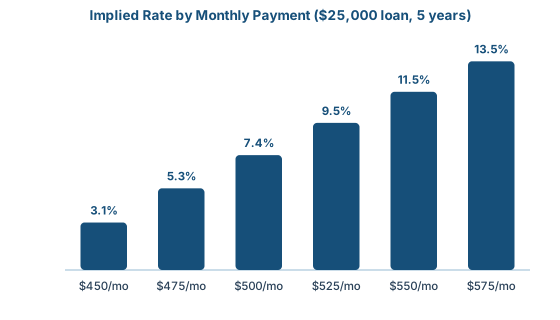
Most "interest calculators" ask you to type in a rate and tell you the payment. This one is built for the opposite, and far less common, situation: you already know your loan amount and your monthly payment — from an old loan document, a car dealer's offer, or a "buy now, pay later" plan that never actually stated a rate — and you want to know what interest rate that actually works out to.
That's genuinely useful, because payment amounts are easy to compare on the surface but easy to obscure the real cost behind. This page has two tools: one solves for the rate itself, and one solves for the true APR once upfront fees are factored in — since a lower stated rate with high fees can end up more expensive than a slightly higher rate with none.
Why You Can't Just "Solve the Formula" for Rate
The standard loan payment formula is:
Payment = P × r × (1+r)ⁿ ÷ [(1+r)ⁿ − 1]
Notice the rate r appears both outside the brackets and inside an exponent. There's no way to algebraically rearrange this to isolate r — which is exactly why almost no calculator offers this "solve for rate" direction. Instead, this tool uses bisection: it repeatedly tests candidate rates, checks whether the resulting payment is too high or too low, and narrows the range until it converges on the exact rate — the same general approach spreadsheet functions like Excel's RATE() use internally.
Interest Rate vs. APR: Why They're Not the Same Number
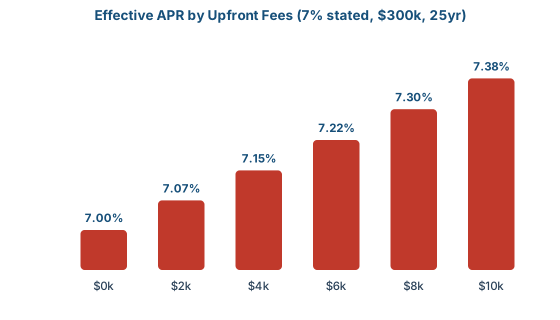
Your interest rate is the cost applied directly to your loan balance. Your APR (Annual Percentage Rate) rolls in upfront costs — origination fees, points, certain closing costs — and spreads their effect across the loan term, showing your true annual cost of borrowing. Lenders are required to disclose APR precisely because the stated rate alone can make two offers look more similar than they really are.
Why Loan Term Changes How Much Fees Actually Cost You
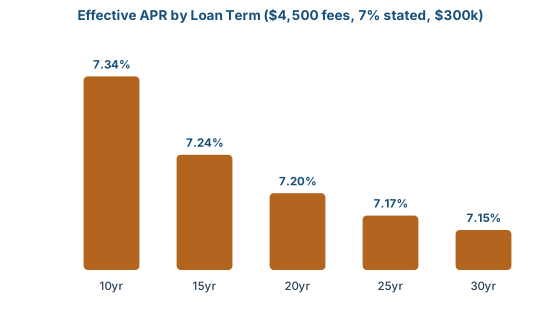
A fixed dollar fee matters more on a shorter loan, because it's spread across fewer, larger payments instead of many small ones:
Why the Rate Matters So Much Over Time
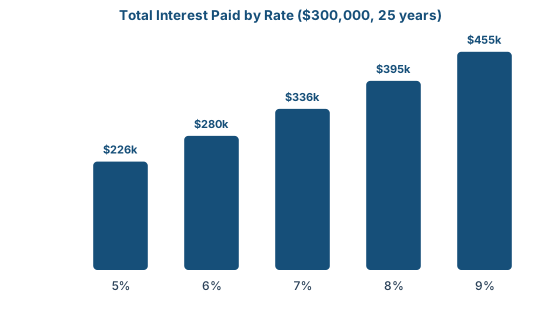
This is the reason it's worth the effort to find your true rate rather than trust the number on a flyer:
How to Use the "Find the Rate" Tool
- Enter your loan amount — the amount originally borrowed.
- Enter your monthly payment — from your loan statement or offer.
- Enter the loan term in years.
- Click Calculate Rate to see the exact annual interest rate, plus a breakdown of how much of your total payments is principal versus interest.
How to Use the "Find the APR" Tool
- Enter the loan amount before fees are deducted.
- Enter the stated interest rate the lender quoted you.
- Enter the loan term in years.
- Enter any upfront fees or points being financed or deducted from your proceeds.
- Click Calculate APR to see your true effective annual rate.
Who This Calculator Is For
- Comparing loan offers that quote different combinations of rate and fees.
- Checking an old loan or car finance agreement where the rate was never clearly stated, only the payment.
- Verifying a lender's APR disclosure independently before signing.
- Understanding "0% financing" offers that bundle in a higher purchase price or added fees instead of a stated rate.
A Note on Accuracy
Both tools on this page use exact numerical methods, not approximations or lookup tables — the solved rate is accurate to a tiny fraction of a percent. Real-world APR disclosures can differ slightly due to regulatory conventions (like how odd first-payment periods are handled), but the math here matches the standard actuarial method lenders use for standard amortizing loans.
Frequently Asked Questions (FAQs)
How is this different from a regular loan payment calculator?
A regular loan calculator takes the interest rate as an input and calculates your payment. This tool works the other way around: you already know your loan amount, payment, and term, and it solves for the interest rate you're actually being charged.
Why isn't there a simple formula to solve for the interest rate?
The standard loan payment formula can't be rearranged algebraically to isolate the rate — the rate appears both inside and outside a power term. This calculator instead tests rates using bisection, a numerical method that narrows in on the correct answer to a precise tolerance, the same general approach spreadsheet functions like RATE() use internally.
What is the difference between interest rate and APR?
The interest rate is the stated cost of borrowing applied to your loan balance. APR (Annual Percentage Yield for deposits, or Annual Percentage Rate for loans) also factors in upfront fees, points, and certain other costs, spreading them across the loan term to show your true effective yearly cost. APR is almost always higher than the stated rate on a loan with fees.
Why does a shorter loan term make fees increase the APR more?
A fixed dollar amount of fees is spread across fewer total payments on a shorter loan, so it represents a bigger share of each payment's cost. On a longer loan, the same fee is diluted across many more payments, so it has a smaller effect on the effective rate.
Can I use this for a savings account or investment instead of a loan?
The rate-solving tool is built around loan-style payments. For working out a savings or investment growth rate from a starting and ending balance, our standard Interest Calculator is the more direct tool to use.
Is the solved interest rate exact?
Yes, to a very high precision. The bisection method used here narrows the answer down to within a tiny fraction of a percent, far more precise than typically needed for real financial decisions.
Is this calculator free to use?
Yes, completely free with no registration required, and you can run unlimited calculations.
At the End
An Interest Rate Calculator that actually solves for the rate — instead of just requiring you to already know it — is a genuinely different tool from a standard loan calculator. Whether you're decoding an old payment agreement or checking a lender's APR math, these two tools turn payment numbers back into the real rate behind them.
This calculator provides mathematical estimates for planning purposes only and is not financial advice. Confirm exact figures, including official APR disclosures, with your lender.