EMI Calculator
Calculate EMI + Full Loan Amortization Schedule
EMI Calculator
Monthly Amortization Schedule
| Month | EMI | Principal | Interest | Balance |
|---|
What Is an EMI Calculator?
An EMI Calculator is a free online tool that computes your Equated Monthly Installment for any loan. Enter three values — the loan amount, the interest rate, and the loan tenure — and it instantly returns the exact monthly payment you'll need to make, along with a currency toggle (USD/INR), a bi-weekly repayment option, and a full amortization schedule broken down period by period.
EMI stands for Equated Monthly Installment. It is the fixed amount you pay to your bank or lending institution every month until the loan is fully repaid. "Equated" means the payment stays the same throughout the tenure, even though the internal split between principal and interest shifts every period.
Every EMI is made up of two parts:
Principal Component — the portion of your payment that reduces the outstanding loan balance.
Interest Component — the fee you pay to the lender for borrowing money.
In the early months of your loan, the interest component is large because the outstanding balance is high. As you keep paying, the balance shrinks, and more of each EMI goes toward reducing the principal. This is called the reducing balance method, and it's the standard used by banks and financial institutions worldwide.
EMI Formula Explained
The EMI Calculator uses the standard formula adopted by banks and financial institutions globally.
The Standard EMI Formula:
Where:
- P = Principal loan amount
- R = Periodic interest rate = Annual Interest Rate / 12 / 100 (monthly), or / 26 / 100 for the bi-weekly option
- N = Total number of installments = Loan Tenure in Years × 12 (monthly), or × 26 for bi-weekly
Manual Calculation Example (Monthly):
Loan Amount = $100,000 | Annual Interest Rate = 9% | Tenure = 10 years
R = 9 / 12 / 100 = 0.0075 | N = 10 × 12 = 120
EMI = [100,000 × 0.0075 × (1.0075)^120] / [(1.0075)^120 − 1]
EMI ≈ $1,266.76 per month
Total Payment = $1,266.76 × 120 = $152,010.93
Total Interest = $152,010.93 − $100,000 = $52,010.93
How EMI Works: Principal vs Interest Breakdown
Each month, the lender calculates interest only on the remaining outstanding balance, not the original loan amount:
- Interest is calculated on the current outstanding balance.
- Your EMI first covers that period's interest charge.
- Whatever is left reduces the principal balance.
- The next period, interest is calculated on the new, lower balance.
This is why early payments are interest-heavy and later payments are principal-heavy.
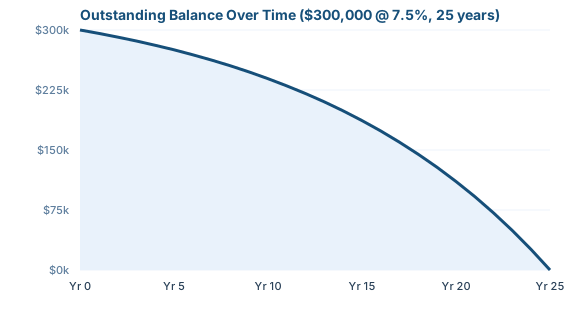
Amortization Example: $200,000 Loan at 8% for 20 Years (EMI = $1,672.88)
- Month 1: Interest = $1,333.33 | Principal = $339.55 | Balance = $199,660.45
- Month 60: Interest = $1,170.36 | Principal = $502.52 | Balance = $175,051.17
- Month 120: Interest = $924.20 | Principal = $748.68 | Balance = $137,881.26
- Month 180: Interest = $557.46 | Principal = $1,115.42 | Balance = $82,503.83
- Month 240: Interest = $11.08 | Principal = $1,661.80 | Balance = $0.00
At Month 1, nearly 80% of the EMI is interest. By the final payment, almost the entire EMI is pure principal. Key Insight: a lump-sum prepayment in the first few years saves far more interest than the same prepayment made later, because it eliminates future interest on a still-large outstanding balance.
How Interest Rate Changes Your EMI
Interest rate has a compounding effect on your monthly payment. On the same $300,000 loan over 20 years, moving from 6% to 11% adds nearly $950 to your monthly payment:
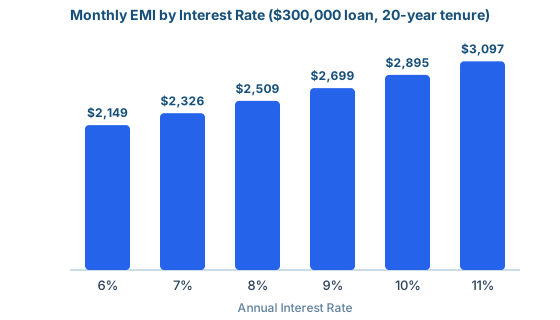
Even a 0.5% rate difference is worth negotiating for — on a large, long-tenure loan it can be worth thousands of dollars over the full term.
Loan Tenure: Lower EMI vs. More Total Interest
Extending the tenure lowers your monthly EMI but increases the total interest paid. On a $300,000 loan at 8%, stretching from 10 to 30 years cuts the EMI by about 40% — but more than triples the total interest paid:
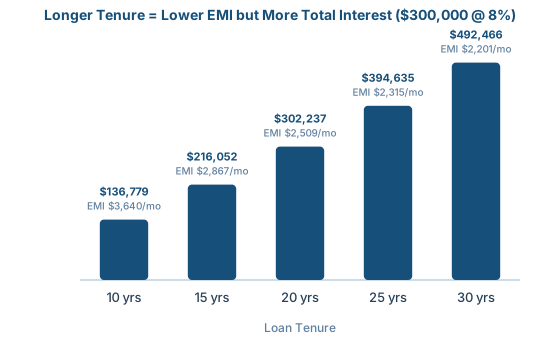
Use the calculator above to test a couple of tenure options for your own loan amount before deciding — the "affordable monthly payment" and the "cheapest total cost" are often two different answers.
Real-Life Loan Examples
Four common loan scenarios, each independently verified with the EMI formula above — enter these exact numbers into the calculator to check them yourself.
Example 1: Home Loan
Loan Amount: $300,000 | Interest Rate: 7.5% | Tenure: 25 years
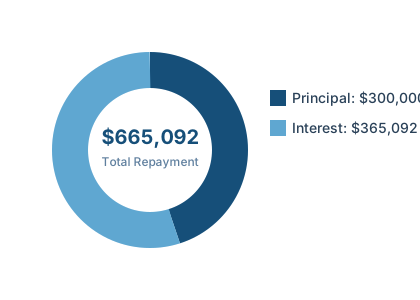
Monthly EMI: $2,216.97 | Total Interest: $365,092.06 | Total Payment: $665,092.06
Example 2: Car Loan
Loan Amount: $30,000 | Interest Rate: 9% | Tenure: 5 years
Monthly EMI: $622.75 | Total Interest: $7,365.04 | Total Payment: $37,365.04
Example 3: Personal Loan
Loan Amount: $10,000 | Interest Rate: 14% | Tenure: 3 years
Monthly EMI: $341.78 | Total Interest: $2,303.95 | Total Payment: $12,303.95
Example 4: Business Loan
Loan Amount: $150,000 | Interest Rate: 11% | Tenure: 7 years
Monthly EMI: $2,568.37 | Total Interest: $65,742.70 | Total Payment: $215,742.70
These examples highlight a critical financial reality: the longer the tenure, the more total interest you pay. The home loan example above results in a total repayment of over $665,000 on a $300,000 loan — more than double the amount borrowed. Choosing the shortest tenure you can comfortably afford is almost always the cheaper path over the life of the loan.
Types of Loans and EMI
- Home Loan EMI — Long-term (15–30 years), relatively low rates (roughly 6.5%–9% in typical markets). Even a 0.25% rate difference can save tens of thousands over the loan's life.
- Car Loan EMI — Typically 7%–12% with 3–7 year tenures. Compare a 5-year vs 7-year tenure to see the real cost difference.
- Personal Loan EMI — Unsecured, higher rates (roughly 10%–24%). Well suited to short-term needs; expensive over long periods.
- Education Loan EMI — Usually includes a moratorium period during study; EMI is calculated on the total amount disbursed once repayment begins. Rates commonly range 8%–13%.
- Business Loan EMI — Rates commonly range 9%–18% depending on credit history and lender policy. Confirm projected revenue comfortably covers the EMI before committing.
Is "EMI" Used Everywhere?
EMI is the everyday term for a fixed monthly loan payment in India, Pakistan, Bangladesh, and other South Asian markets, where it's part of common financial vocabulary. In the US, UK, and most other countries, the same concept is usually just called a "monthly payment" or "installment." The math behind it is identical everywhere — that's why this calculator includes a currency toggle rather than assuming one region, so it works whether you're budgeting in dollars, rupees, or another currency.
Benefits of Using an EMI Calculator
- Instant and Accurate Results. The EMI formula involves exponent math that's easy to get wrong manually — this tool computes it precisely in milliseconds.
- Better Loan Comparison. Run multiple rate/tenure combinations to compare the true total cost of each option.
- Smart Monthly Budget Planning. Know your exact EMI before taking the loan so you can check it fits comfortably within your income.
- Full Amortization Schedule. See exactly how much of each payment goes to interest vs. principal.
- Prepayment Planning. Use the schedule to identify the best time to make a lump-sum prepayment.
- Completely Free. No registration, unlimited calculations, works on any device.
Financial Rule of Thumb: Many lenders look for your combined monthly EMI obligations across all loans to stay under roughly 40% of your monthly net income — use this calculator to check where a new loan would put you.
Tips to Reduce Your EMI
- Increase Your Down Payment — a smaller principal directly reduces the EMI.
- Negotiate a Lower Interest Rate — a strong credit score gives you leverage; even 0.5% saved compounds significantly over a long tenure.
- Extend the Loan Tenure — lowers the monthly EMI but increases total interest paid (see the tenure chart above).
- Make Periodic Prepayments — put bonuses or surplus income toward reducing principal, which shortens the tenure or lowers future EMIs.
- Consider a Balance Transfer — moving an existing loan to a lower-rate lender can reduce EMI; run the new terms through this calculator first, factoring in any transfer fees.
- Build a Better Credit Score — pay existing EMIs on time and keep credit utilization low to qualify for better rates.
Frequently Asked Questions (FAQs)
What is an EMI Calculator and how does it work?
An EMI Calculator is a free online tool that computes your monthly loan installment using three inputs: loan amount, interest rate, and tenure. It applies the standard EMI formula to instantly deliver the monthly payment amount, total interest payable, and a full amortization schedule.
Is the EMI the same every month throughout the loan?
Yes, for fixed-rate loans the EMI amount stays constant every month. However, the split between interest and principal changes each month — more interest in early months, more principal in later months. For floating-rate loans, the EMI may be revised when the interest rate changes.
What happens if I miss an EMI payment?
Missing an EMI results in a late payment penalty and a negative mark on your credit report. Repeated missed payments can seriously damage your credit score, trigger penal interest charges, and ultimately lead to loan default proceedings. Set up automatic payments or reminders to never miss an EMI.
Can I reduce my EMI after the loan has been disbursed?
Yes. You can reduce your EMI by making a partial prepayment (which lowers the outstanding balance), requesting a tenure extension from your lender, or doing a balance transfer to a lender offering a lower interest rate.
Does a longer tenure always mean a lower EMI?
Yes, a longer tenure reduces the monthly EMI — but it significantly increases the total interest paid over the life of the loan. Always compare total repayment amounts, not just monthly installments, when choosing between tenures.
How accurate is an online EMI Calculator?
Online EMI Calculators are highly accurate as they use the same formula as banks. Minor differences from the actual bank EMI may occur due to processing fees, rounding conventions, bundled insurance premiums, or taxes. Treat the EMI Calculator result as a reliable estimate and confirm final terms with your lender.
What is an amortization schedule?
An amortization schedule is a complete month-by-month table of every EMI payment over the entire loan tenure. For each month, it shows the EMI amount, how much goes to interest, how much reduces the principal, and the remaining outstanding balance.
When is the best time to make a prepayment?
The best time to prepay is in the early years of the loan when the outstanding balance is highest. Prepaying early eliminates future interest on a large balance, resulting in maximum savings. Always check for prepayment charges with your lender before proceeding.
What credit score do I need for the best loan rates?
A credit score of 750 or above is generally considered excellent and qualifies you for the lowest interest rates. Scores between 700–749 are good but may attract slightly higher rates. Scores below 650 may lead to loan rejection or significantly higher interest rates.
Is this EMI Calculator free to use?
Yes. Our EMI Calculator is completely free — no registration, no login, no hidden fees. You can calculate EMI for unlimited loan scenarios at any time.
Is EMI used only in India, or is the term used elsewhere too?
EMI is the standard term for a fixed monthly loan payment in India, Pakistan, Bangladesh, and other South Asian markets. In the US, UK, and most other countries the same concept is usually called a monthly installment or loan payment. The underlying math is identical, so this calculator works for any currency or country.
Conclusion
An EMI Calculator is one of the most practical financial tools available to any borrower. Whether you're buying a home, financing a car, consolidating debt, or funding a business expansion — calculating your EMI before signing any loan agreement is a non-negotiable step in responsible financial planning. Combined with a full amortization schedule and visual charts, it gives you the full picture: compare options side by side, plan strategic prepayments, and make informed borrowing decisions in seconds.
This calculator provides estimates for planning purposes only and is not financial advice. Actual loan terms, fees, and rates vary by lender — always confirm final numbers with your bank or financial institution before signing an agreement.