GPA and CGPA Calculator
Calculate your semester GPA, your cumulative CGPA across multiple terms, or convert a percentage to the standard 4.0 scale — all in one place.
GPA and CGPA Calculator – Calculate Your Academic Score Instantly
Navigating the world of academic grading can often feel like decoding a complex puzzle. Whether you are a high school student eyeing a top-tier college or a university senior preparing for graduation, your grades are the primary currency of your academic success. Two terms you will encounter constantly are GPA and CGPA — and if you're applying internationally, a percentage or a country-specific scale on top of that.
Understanding these metrics is crucial for tracking your progress, meeting scholarship requirements, and applying for internships. Manual calculations can be tedious and prone to errors, especially once credit-weighting is involved. That's what the three tools above are for — a semester GPA calculator, a cumulative CGPA calculator, and a percentage-to-GPA converter for the standard US scale.
What Is a GPA and CGPA Calculator?
A GPA and CGPA calculator is a digital tool that helps students convert their letter grades or percentages into a standardized numerical scale. Instead of spending time with pen, paper, and a scientific calculator, students input their grades and credit hours and get an instant, accurate result.
Why Students Use These Calculators
- Predict Future Grades: Plug in potential grades for current classes to see how they'd affect your overall standing.
- Scholarship Eligibility: Many financial aid programs require a minimum 3.0 or 3.5 GPA.
- Accuracy: Manual math often leads to mistakes with weighted credits — a calculator ensures the math is exact every time.
- International Applications: Students applying to US schools from a percentage- or 10-point-based system need to estimate their US-equivalent GPA.
What Is GPA (Grade Point Average)?
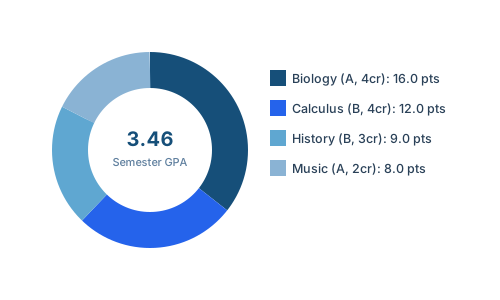
GPA represents the average value of your accumulated grades for a specific term or semester, usually on a 0.0–4.0 scale (weighted scales for Honors/AP classes can go up to 5.0). Think of GPA as a snapshot of one semester's performance.
What Is CGPA (Cumulative Grade Point Average)?
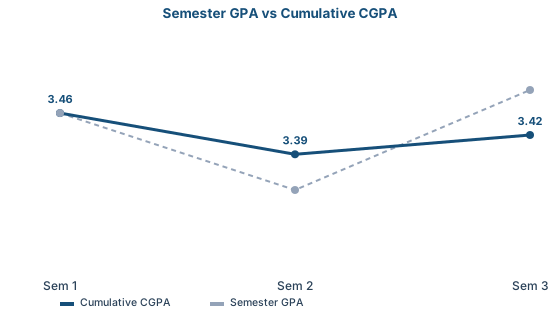
While GPA looks at a single semester, CGPA looks at the bigger picture — the credit-weighted average of every grade earned across your entire program, from day one to the current moment. It's the number most employers and graduate schools look at, since it reflects consistency over time rather than a single term.
Difference Between GPA and CGPA
| Feature | GPA | CGPA |
|---|---|---|
| Scope | One specific semester or term. | The entire duration of the course. |
| Duration | Short-term (e.g., 4–6 months). | Long-term (e.g., 2–4 years). |
| Focus | Shows current performance. | Shows overall academic consistency. |
| Calculation | Based on grades/credits of one term. | Credit-weighted average of all terms. |
How to Calculate GPA
You need two things for each course: the grade you received, and the credit hours it's worth. Credit hours are the "weight" — a 4-credit lab science counts for more than a 1-credit elective.
The GPA Formula
Steps to Calculate:
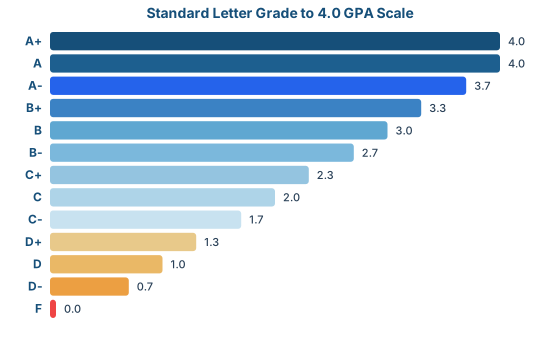
- Assign Point Values: Convert letter grades to points (A=4.0, B=3.0, C=2.0, D=1.0, F=0.0, or the full +/- scale below).
- Calculate Quality Points: Multiply each grade's point value by that course's credit hours.
- Sum Everything: Add up all quality points, and separately, all credit hours.
- Divide: Total quality points ÷ total credit hours = your GPA.
Standard Letter Grade to GPA Scale
This is the most widely used US plus/minus scale. Exact cutoffs vary by school, so always check your syllabus — but this covers the large majority of US institutions:
Why Credit Hours Matter So Much
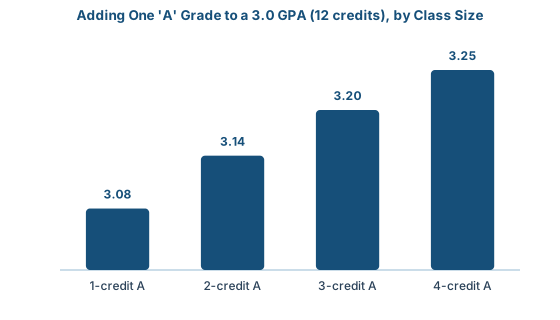
Because GPA is credit-weighted, the same letter grade affects your GPA differently depending on the class size:
Example of GPA Calculation
| Subject | Grade | Grade Points | Credit Hours | Total Quality Points |
|---|---|---|---|---|
| Biology | A | 4.0 | 4 | 16.0 |
| Calculus | B | 3.0 | 4 | 12.0 |
| History | B | 3.0 | 3 | 9.0 |
| Music | A | 4.0 | 2 | 8.0 |
| Total | 13 | 45.0 |
Example of CGPA Calculation
Extending the example above across three semesters:
- Semester 1: 45.0 Points | 13 Credits
- Semester 2: 50.0 Points | 15 Credits
- Semester 3: 42.0 Points | 12 Credits
Total Points: 45 + 50 + 42 = 137 | Total Credits: 13 + 15 + 12 = 40
Some schools instead simply average each semester's GPA without weighting by credits (here, that would give (3.46+3.33+3.50)/3 ≈ 3.43 too, though the two methods can diverge more when semester credit loads vary) — the credit-weighted method above is the more accurate standard, and the one this calculator uses.
Percentage to GPA: A Word of Caution
If you're converting a percentage or a 10-point CGPA (common in India and several other countries) to a US-style 4.0 GPA, be aware: there is no single universal formula. The converter above applies the standard US percentage-range scale (90-100% ≈ 4.0 range, 80-89% ≈ 3.0 range, and so on), which is a reasonable general estimate — but many US universities publish their own official conversion table, and some international grading bodies use very different scales entirely (a 10-point CGPA is not simply "divided by 2.5"). For anything that affects an actual application or transcript, always check your target institution's official conversion policy rather than relying on any online estimate, including this one.
How to Use These Calculators
- Pick a Tool: GPA for one semester, CGPA for your cumulative record, or % to GPA to convert a percentage score.
- Enter Course Names (Optional): Helps you track which grade belongs to which class.
- Enter Grades and Credit Hours: Select the letter grade and input the credit weight for each course.
- Add More Rows: Click "Add Course" or "Add Semester" as needed.
- Calculate: Click the button to see your result instantly, with a visual breakdown.
Benefits of Using a GPA and CGPA Calculator
Who Should Use a GPA Calculator?
- High School Students: Track GPA for college applications, especially weighted GPA from honors classes.
- College and University Students: Monitor academic standing and major requirements across complex credit systems.
- International Applicants: Estimate a US-equivalent GPA from a percentage or other national grading scale.
- Academic Advisors: Build recovery plans or verify graduation honors like Cum Laude.
Tips to Improve Your GPA
- Prioritize High-Credit Classes: An 'A' in a 4-credit class helps your GPA more than an 'A' in a 1-credit class.
- Attend Office Hours: Better understanding often shows up in better grades on subjective assignments.
- Form Study Groups: Explaining a concept to someone else is one of the best ways to master it yourself.
- Manage Your Time: Avoid last-minute cramming, which tends to produce lower test scores.
- Retake Courses If Allowed: Replacing a poor grade can meaningfully boost your CGPA where policy permits it.