Golf Club Length Calculator – Find Your Fit by Height & Wrist-to-Floor
Golf Club Length Calculator
Note: This calculator provides a general static-fitting estimate using the same method club fitters start with. Professional dynamic fitting is recommended for competitive or serious players.
Golf Club Length Calculator: The Ultimate Guide to Finding Your Perfect Fit
Have you ever wondered why your shots slice into the woods, or why you feel like you're "reaching" for the ball? The culprit might not be your swing — it might be your equipment.
In golf, half an inch of club length can be the difference between a clean strike and a mishit. Using the wrong club length forces your body to compensate, leading to poor posture and inconsistent contact. Whether you're a tall player hunched over or a shorter player struggling with "too much" club, finding your fit is one of the cheapest ways to lower your scores.
Our Golf Club Length Calculator uses your height and your wrist-to-floor measurement together — not height alone — to take the guesswork out of the equation.
What Is a Golf Club Length Calculator?
A Golf Club Length Calculator is a digital tool that determines the ideal length adjustment for your golf clubs based on two physical data points: your total height and your wrist-to-floor measurement.
Most golf clubs sold in retail stores are built to "standard" specifications, designed for a golfer roughly 5'9" to 6'0" with proportionate arm length. Very few golfers fit that exact mold. This tool works as a golf club fitting calculator, recommending whether you need standard length or should add or subtract inches to optimize your setup.
Why Golf Club Length Is Important
Using the correct club length is about more than comfort — it's physics.
- Increased Accuracy: When a club is too long, the toe tends to sit up at address, which can pull shots left. If it's too short, the heel lifts, which can push shots right. Correct length helps the clubface sit flush at impact.
- Swing Consistency: A properly fitted club lets you keep an athletic, balanced posture without artificially crouching or standing tall, which helps your muscle memory develop consistently.
- Better Contact: Hitting the sweet spot of the clubface more often increases ball speed. Simply put: the right length leads to more distance and more control, not one at the expense of the other.
How This Calculator Works
This tool uses the "static fitting" approach club fitters use as a starting point, combining two signals:
- Wrist-to-Floor Measurement: The primary signal. It reflects your arm length relative to your body far better than height alone.
- Total Height: A secondary signal. Two golfers can share the same wrist-to-floor number but different heights — height still nudges the recommendation, just with less weight than wrist-to-floor.
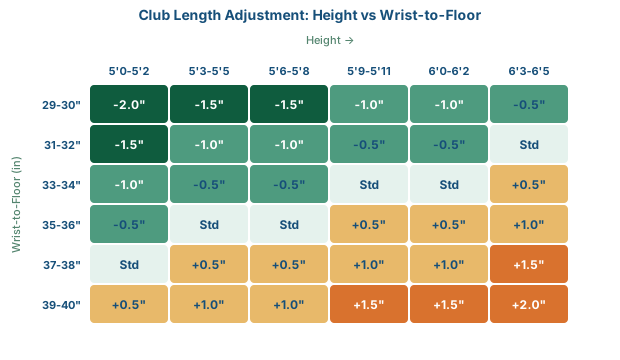
That combination matters: a tall golfer with long arms (a low wrist-to-floor for their height) may need standard-length clubs despite being tall, while a shorter golfer with short arms (a high wrist-to-floor for their height) may actually need slightly longer clubs. Height by itself would get both of these golfers wrong.
How to Measure Wrist-to-Floor Correctly (Step-by-Step)
- Wear your golf shoes: Since you play in shoes, measure in them to account for that extra height.
- Stand on a hard, flat surface: Avoid thick carpet; stand on tile or wood if possible.
- Stand tall, but relaxed: Feet shoulder-width apart, arms hanging naturally at your sides. Don't reach down or shrug your shoulders up.
- Find the crease: Have a friend measure from the primary crease in your wrist (where hand meets arm) straight down to the floor.
- Record the number: Note the measurement in inches to enter into the calculator.
Common mistake: measuring alone. It's nearly impossible to get an accurate wrist-to-floor number by yourself — you'll naturally lean over to read the tape, which skews the result. Get a second person to measure for you.
How Sensitive Is the Recommendation to Each Measurement?
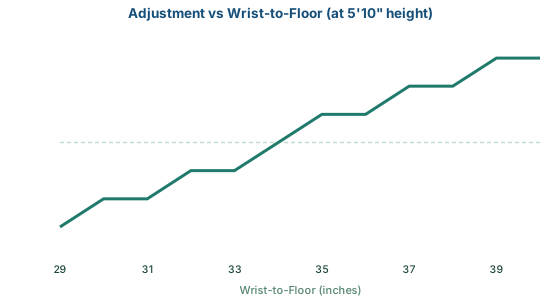
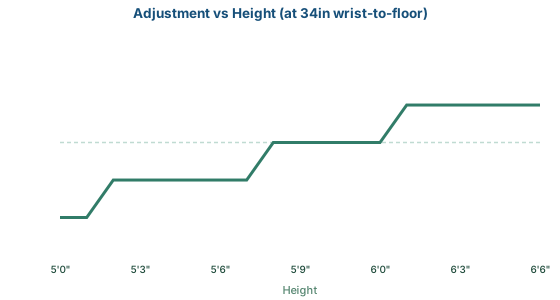
Wrist-to-floor moves the recommendation faster than height does — which is exactly why relying on height alone (as many simplified "calculators" do) gets the fit wrong for anyone with above- or below-average arm length:
Example Calculations (Real Scenarios)
Example 1: The "Long Arms" Case
Player: 6'1" Tall | Wrist-to-Floor: 33"
Even though this player is tall, their long arms bring their wrist-to-floor measurement down close to average.
Result: Standard length. Adding length here would actually make the clubs feel unwieldy.
Example 2: Slightly Above Average
Player: 5'10" Tall | Wrist-to-Floor: 35"
Close to average height with a slightly higher wrist-to-floor than typical for that height.
Result: +0.5" longer than standard.
Example 3: The "Short Arms" Case
Player: 5'8" Tall | Wrist-to-Floor: 37"
This player is shorter than average but has a high wrist-to-floor measurement — short arms relative to height.
Result: +0.5" longer than standard. This helps avoid bending over too far at address.
Standard Golf Club Length Chart
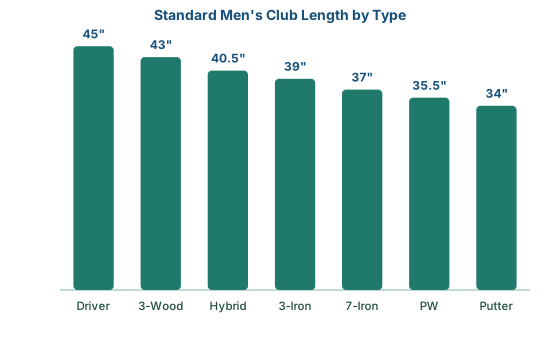
For a men's 7-iron, the standard is usually 37 inches; for women, about 36 inches. Standard men's drivers run about 45 inches. Your recommended adjustment from this calculator applies on top of whichever standard length your specific club type starts from.
Factors That Affect Golf Club Length Beyond This Calculator
- Posture: A golfer who prefers a deeper crouch at address may do well with slightly shorter clubs than this calculator suggests.
- Swing Style: A steep swing and a shallow, sweeping swing can respond differently to the same nominal length.
- Physical Limitations: Golfers with back issues often prefer slightly longer clubs to reduce how far they need to bend over.
Benefits of Using This Calculator
Beginner Tips for Choosing the Right Club Length
- Prioritize the Irons: If you can only customize one category, start with irons — they demand the most precision.
- Test Before You Cut: If the calculator says -0.5", try choking down on your current clubs first to see how the contact feels before paying to alter them.
- Don't Forget the Putter: Putter length is fitted separately, based on posture and eye-line over the ball, not this height/wrist-to-floor method.
Common Mistakes to Avoid
- Measuring Alone: As noted above, get a second person to measure your wrist-to-floor.
- Ignoring Lie Angle: Length and lie angle interact — changing one often means checking the other.
- Assuming Height Is Everything: Never fit clubs on height alone. Arm length is the real deciding factor, which is why this calculator asks for both.
Do You Still Need Professional Fitting?
This calculator is a solid "static" starting point and gets most recreational golfers most of the way there. A professional "dynamic" fitting — where a fitter watches you hit real shots — can fine-tune length, lie angle, and shaft choice further. If you're a scratch golfer or competing seriously, that investment is worth it. For most recreational golfers, this calculator provides a strong blueprint for a great-fitting set.
Golf Club Length vs. Lie Angle
These two terms often get mentioned together. Length is how long the shaft is; lie angle is the angle between the shaft and the sole of the clubhead. If your clubs are too long for you, they tend to behave as if the lie angle is too upright — so correcting the length often improves minor lie-angle issues too.