Discount Formula with Examples
What Is a Discount?
A discount is a reduction in the original price of a product or service. It is the amount by which the marked price is lowered to arrive at the final selling price. Discounts are offered by businesses to attract customers, clear old stock, reward loyal buyers, or run promotional sales.
When you see a tag that says "30% off" or "Save $50," that is a discount in action. Understanding the discount formula helps you calculate exactly how much you are saving, what the final price will be, and what the original price was before the reduction.
Discounts are used in retail stores, e-commerce platforms, wholesale trade, banking offers, and service industries. Whether you are a buyer trying to find the best deal or a seller setting a promotional price, the discount formula is an essential tool.
Key Terms You Must Know
Before applying the formula, it is important to understand these terms:
Marked Price (MP) — The original price of a product as listed or tagged before any discount. Also called the list price or original price.
Selling Price (SP) — The final price at which the product is sold after the discount is applied.
Discount — The actual amount reduced from the marked price. Discount = MP − SP
Discount Percentage — The discount expressed as a percentage of the marked price.
The Discount Formula
The standard formula for discount is:
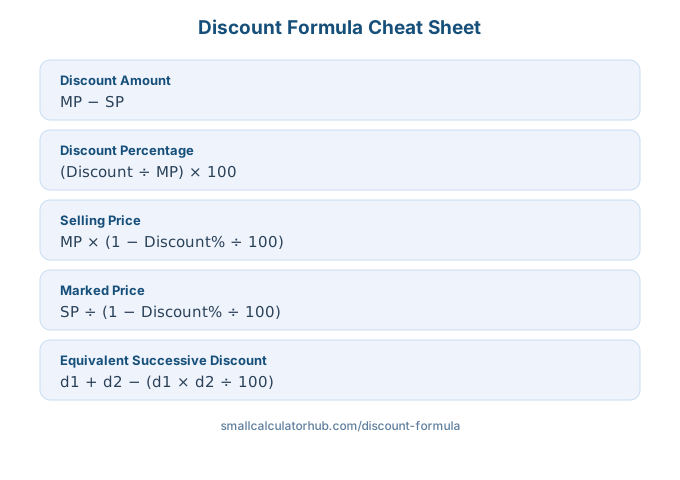
Discount = Marked Price − Selling Price
Discount Percentage = (Discount / Marked Price) × 100
Or written in full:
Discount % = [(MP − SP) / MP] × 100
You can rearrange this formula to find other unknowns:
- To find Selling Price: SP = MP × (1 − Discount% / 100)
- To find Marked Price: MP = SP / (1 − Discount% / 100)
- To find Discount Amount: Discount = (Discount% / 100) × MP
Step-by-Step Examples
Example 1 — Finding Discount Percentage
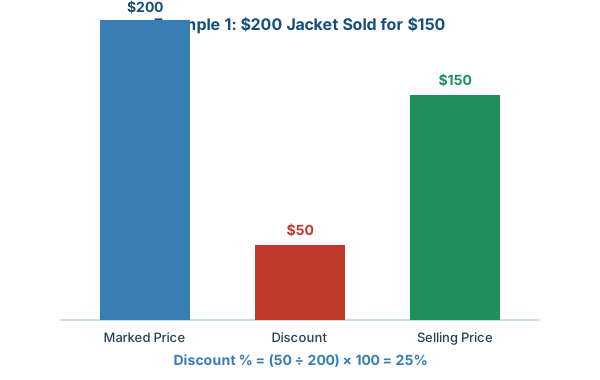
Problem: A jacket has a marked price of $200 and is sold for $150. What is the discount percentage?
MP = 200, SP = 150
Discount = MP − SP = 200 − 150 = 50
Discount % = (Discount / MP) × 100 = (50 / 200) × 100 = 0.25 × 100
Answer: 25% discount
Example 2 — Finding the Selling Price
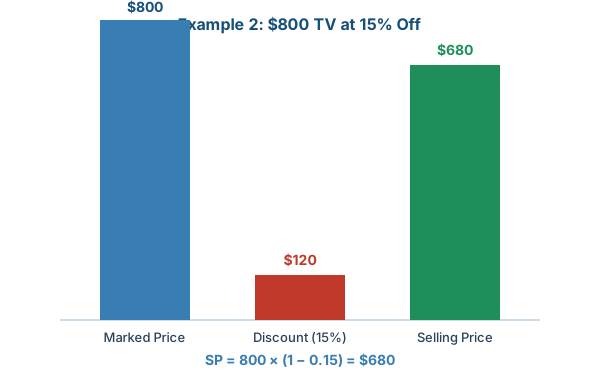
Problem: A television is marked at $800. A discount of 15% is offered. What is the selling price?
MP = 800, Discount % = 15
SP = MP × (1 − Discount% / 100) = 800 × 0.85
Answer: SP = $680
Example 3 — Finding the Marked Price
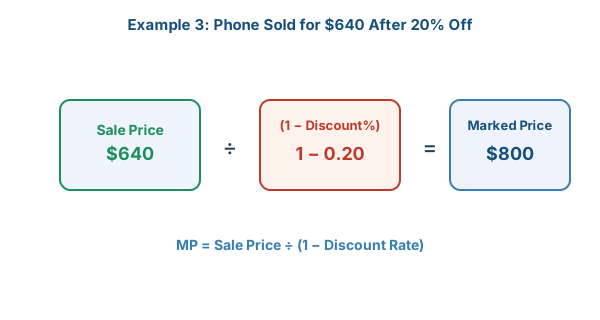
Problem: After a 20% discount, a phone is sold for $640. What was the original marked price?
SP = 640, Discount % = 20
MP = SP / (1 − Discount% / 100) = 640 / 0.80
Answer: MP = $800
Example 4 — Finding the Discount Amount
Problem: A laptop is marked at $1,200 with a 25% discount. How much money is saved?
MP = 1200, Discount % = 25
Discount = (Discount% / 100) × MP = 0.25 × 1200
Answer: Discount = $300
The selling price would be 1200 − 300 = $900.
Example 5 — Successive Discounts
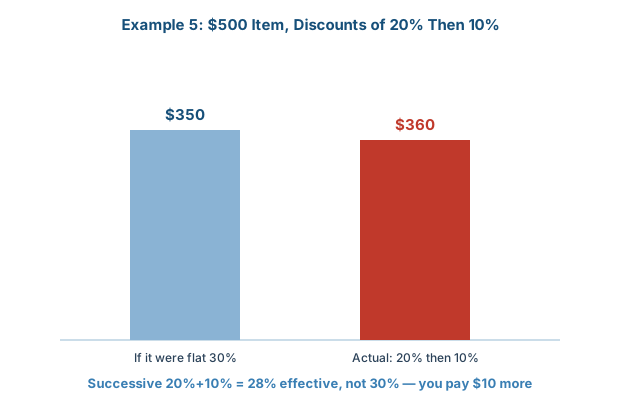
Problem: A store offers two successive discounts of 20% and 10% on a product marked at $500. What is the final selling price?
Successive discounts are applied one after another, not added together.
After the first discount of 20%: SP1 = 500 × 0.80 = $400
After the second discount of 10% on $400: SP2 = 400 × 0.90 = $360
Answer: Final Selling Price = $360
Note: Two successive discounts of 20% and 10% are NOT equal to a single discount of 30%. The actual combined discount is: Total Discount = 500 − 360 = 140 → Discount % = (140 / 500) × 100 = 28%, not 30%.
Example 6 — Discount and Profit Together
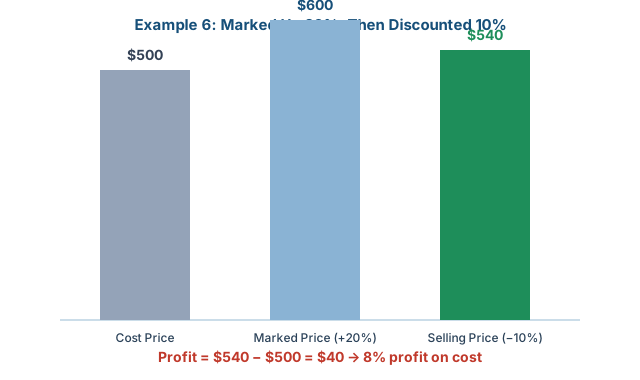
Problem: A shopkeeper marks a product at $600, which is 20% above cost price. He then offers a 10% discount. Does he make a profit or loss and by how much percentage?
MP = 600
CP = 600 / 1.20 = $500
SP = 600 × 0.90 = $540
Profit = SP − CP = 540 − 500 = $40
Profit % = (40 / 500) × 100
Answer: 8% profit
This example shows how businesses mark up prices above cost before applying a discount and still make a profit.
Successive Discount Formula
When two discounts d1% and d2% are applied one after another, the equivalent single discount is:
Equivalent Discount % = d1 + d2 − (d1 × d2) / 100
Example: Two discounts of 20% and 10%:
Equivalent Discount = 20 + 10 − (20 × 10) / 100 = 30 − 2 = 28%
This confirms that successive discounts of 20% and 10% equal a single discount of 28%, not 30%. Our Discount Calculator's "Stacked Discounts" mode runs this exact formula for any two percentages you enter.
Common Discount Mistakes to Avoid
- Adding successive discounts together instead of compounding them (see Example 5 above).
- Confusing discount with loss — discount is on marked price, loss is on cost price; they're calculated on different bases entirely.
- Assuming a percentage discount always beats a fixed-amount discount — which one saves more depends on the item's price.
- Forgetting taxes — many receipts apply sales tax after the discount, so the discount formula alone won't match your final checkout total.
Discount vs Loss — Important Difference
Many people confuse discount and loss. Here is the key difference:
Discount is calculated on the Marked Price (MP).
Loss is calculated on the Cost Price (CP).
A seller can offer a discount and still make a profit — as long as the selling price remains above the cost price. A loss only occurs when the selling price falls below the cost price.
| Situation | Condition |
|---|---|
| Discount offered, SP > CP | MP reduced but SP still above CP → Profit |
| Discount offered, SP = CP | SP equals CP after discount → No profit no loss |
| Discount offered, SP < CP | SP falls below CP after discount → Loss |
Quick Reference — Discount Formulas
| What to Find | Formula |
|---|---|
| Discount Amount | MP − SP |
| Discount Percentage | (Discount / MP) × 100 |
| Selling Price | MP × (1 − Discount% / 100) |
| Marked Price | SP / (1 − Discount% / 100) |
| Equivalent Successive Discount | d1 + d2 − (d1 × d2) / 100 |
How This Formula Powers Our Discount Calculator
Every example above maps directly onto a mode in our Discount Calculator: Examples 1 and 4 match its "Find the Discount %" and "Price After % Discount" modes, Example 3 matches "Find the Original Price," and Example 5 matches "Stacked Discounts." If you'd rather skip the manual arithmetic, plug your own numbers into the calculator and it applies these same formulas instantly.
Related Formulas
The discount formula connects directly to several other important formulas:
- Profit Percentage Formula — a seller applies a discount but still aims to make a profit above cost price; both formulas are often used together (see Example 6 above).
- Loss Percentage Formula — when a discount pushes the selling price below cost price, it results in a loss.
- Percentage Decrease Formula — a discount is essentially a percentage decrease applied to the marked price.
- Simple Interest Formula — discounts on early loan repayments and cash discounts in banking involve related percentage concepts.
Related Calculator
Frequently Asked Questions
What is the discount formula?
The discount formula is: Discount % = (Discount / Marked Price) × 100. Where Discount = Marked Price − Selling Price. It expresses the reduction in price as a percentage of the original marked price.
How do you calculate the selling price after a discount?
Use the formula: SP = MP × (1 − Discount% / 100). For example, if MP = $500 and discount = 20%, then SP = 500 × 0.80 = $400.
How do you find the original price before a discount?
Use the formula: MP = SP / (1 − Discount% / 100). For example, if SP = $360 and discount = 10%, then MP = 360 / 0.90 = $400.
What are successive discounts and how are they calculated?
Successive discounts are two or more discounts applied one after another on the reduced price. They are not simply added together. The equivalent single discount for two discounts d1 and d2 is: d1 + d2 − (d1 × d2) / 100.
What is the difference between discount and rebate?
A discount is a reduction given at the time of purchase, applied directly to the marked price. A rebate is a partial refund given after the purchase is complete, usually as a cashback or reimbursement. Both reduce the effective price but work differently.
Can a seller offer a discount and still make a profit?
Yes. A seller can offer a discount and still make a profit as long as the selling price after the discount remains above the cost price. Sellers often mark up the price above cost before applying a discount, ensuring they still earn a profit on the sale.
Summary
The discount formula — Discount % = (Discount / Marked Price) × 100 — is one of the most practical calculations in retail, commerce, and everyday shopping. It allows buyers to understand how much they are saving and sellers to set strategic promotional prices while managing profitability.
Always remember that discount is calculated on the marked price, not the cost price. Use the rearranged versions of the formula to find the selling price after a discount or to reverse-calculate the original marked price. For successive discounts, always apply them one at a time rather than adding them together.
Ready to run your own numbers? Head to the Discount Calculator for instant results across all five modes covered in this guide.