Loss Percentage Calculator
Find loss percentage, or work backward to find the selling price or cost price you need.
Loss & Profit Calculator
What Is a Loss Percentage Calculator?
Whether you're a business owner reviewing quarterly performance, a student solving profit-and-loss problems, or an investor tracking a portfolio decline, a loss percentage calculator gives instant, accurate answers without manual arithmetic.
A loss percentage calculator works out the exact percentage of loss incurred when the selling price of a product or asset falls below its cost price. Enter the cost price and selling price, and it instantly returns the loss amount and loss percentage — or run it in reverse to solve for the selling price or cost price you'd need to hit a specific target.
What Is Loss Percentage?
A loss occurs when the selling price (SP) of a product is less than its cost price (CP) — in simple terms, you paid more for something than you received when you sold it. Loss percentage expresses that loss as a proportion of the original cost price, shown as a percentage.
Key Terms
| Term | Meaning |
|---|---|
| Cost Price (CP) | The price at which the item was purchased or produced |
| Selling Price (SP) | The price at which the item is sold |
| Loss | The amount by which CP exceeds SP |
| Loss Percentage | Loss expressed as a percentage of CP |
Where Loss Percentage Is Used
- Retail and e-commerce clearance pricing
- Business profit-and-loss statements
- Stock market and investment analysis
- Real estate transactions
- School and competitive exam mathematics
Loss Percentage Formula
Core formulas:
Combined: Loss % = [(CP − SP) ÷ CP] × 100
Reverse Formulas (Now Built Into the Calculator Above)
- Selling Price = Cost Price × (1 − Loss% ÷ 100)
- Cost Price = Selling Price ÷ (1 − Loss% ÷ 100)
Switch the "Calculate" dropdown above to solve either of these directly instead of doing the algebra by hand.
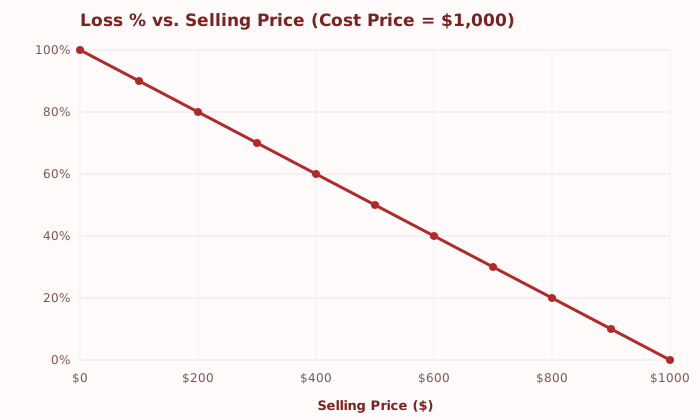
For a fixed $1,000 cost price, loss percentage falls in a straight line — from 100% at a $0 selling price down to 0% once the selling price reaches the cost price.
Loss Percentage vs. Profit Percentage
| Condition | Result | Formula |
|---|---|---|
| SP < CP | Loss | (CP − SP) ÷ CP × 100 |
| SP > CP | Profit | (SP − CP) ÷ CP × 100 |
| SP = CP | No profit, no loss | 0% |
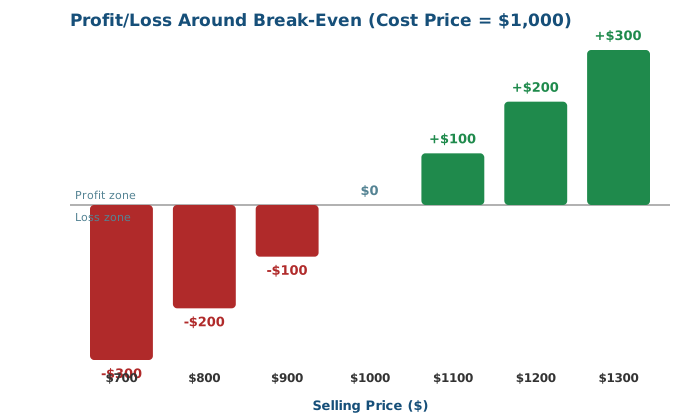
Around a $1,000 break-even point, every dollar the selling price falls short is a dollar of loss (red), and every dollar above it is a dollar of profit (green).
How to Calculate Loss Percentage: Step-by-Step
- Identify the cost price (CP).
- Identify the selling price (SP).
- Confirm CP is greater than SP — if not, it's a profit, not a loss.
- Apply Loss % = [(CP − SP) ÷ CP] × 100.
- Read off the final percentage.
Solved Examples
Example 1 — Find Loss Percentage
Cost Price = $500, Selling Price = $400
Loss = $500 − $400 = $100 → Loss % = (100 ÷ 500) × 100 = 20%
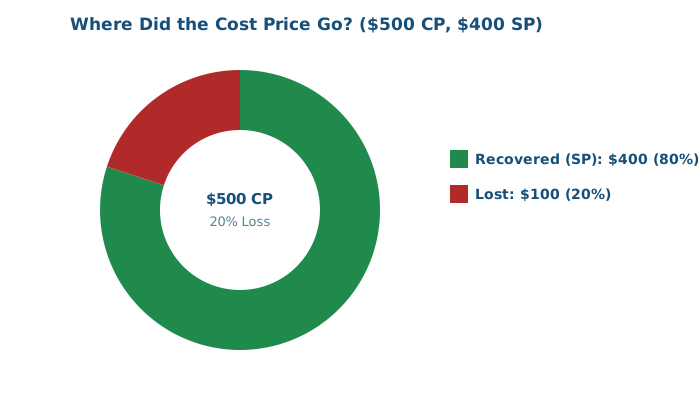
Of the original $500 cost price, $400 (80%) was recovered through the sale and $100 (20%) was lost.
Example 2 — Find Selling Price from a Target Loss %
Cost Price = $1,200, target Loss % = 15%
SP = 1,200 × (1 − 0.15) = $1,020
Example 3 — Find Cost Price from a Target Loss %
Selling Price = $8,500, Loss % = 15%
CP = 8,500 ÷ (1 − 0.15) = $10,000
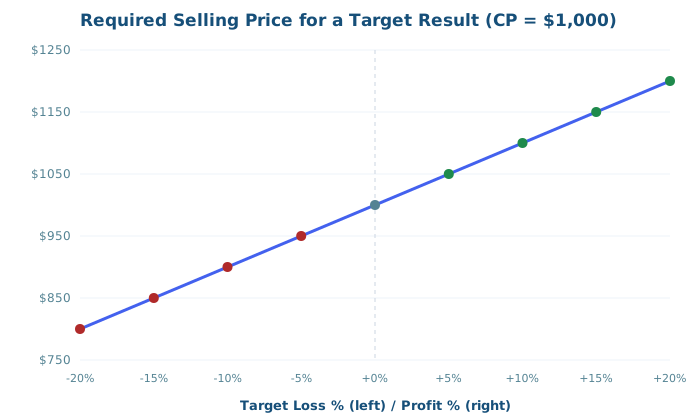
For a $1,000 cost price, hitting a 20% loss target needs an $800 selling price, while hitting a 20% profit target needs $1,200.
Real-World Loss Percentage Examples
| Scenario | Cost Price | Selling Price | Loss % |
|---|---|---|---|
| Grocery perishables | $50 | $45 | 10% |
| Real estate quick sale | $300,000 | $270,000 | 10% |
| Electronics clearance | $800 | $680 | 15% |
| Stock position | $10,000 | $7,500 | 25% |
| Clothing markdown | $60 | $42 | 30% |
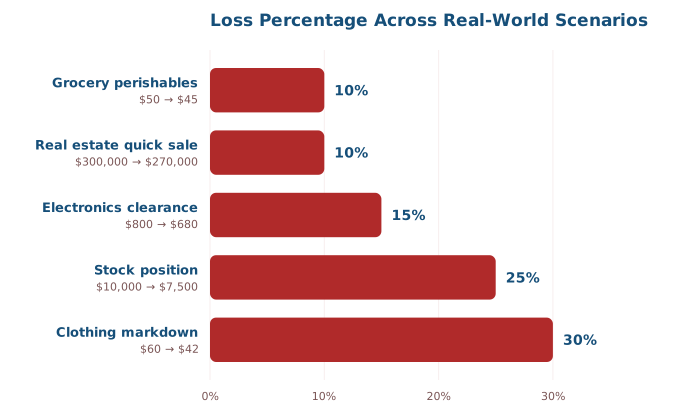
Loss percentage tells you how deep a markdown or decline is, regardless of whether the amounts involved are $5 or $30,000.
Important Rules to Remember
- Loss is always calculated on the cost price, never the selling price.
- If SP = CP, there is no profit or loss.
- Loss percentage cannot exceed 100% in standard trade.
- Use the same currency for CP and SP.
- Include taxes, shipping, and other acquisition costs in CP for an accurate result.
Applications of Loss Percentage
- Retail & e-commerce: Deciding markdown depth on clearance items.
- Business accounting: Reporting losses on financial statements.
- Investing: Tracking percentage decline on a stock or asset position.
- Real estate: Comparing purchase price against a quick-sale price.
- Education: A standard topic in school and competitive exam mathematics.