Discount Calculator
5 modes: percentage off, fixed amount off, find the discount %, find the original price, and stacked discounts.
Calculate
What Is a Discount Calculator and Why Do You Need One?
Every savvy shopper knows that a great deal is only great if you actually understand what you're saving. That's where a discount calculator comes in. Whether you're browsing a clearance sale, comparing coupons, or negotiating a bulk order for your business, a discount calculator gives you the exact numbers — fast, accurately, and without any guesswork.
A discount calculator is a simple yet powerful tool that computes the final price of an item after a percentage or fixed amount has been deducted from the original price. Instead of doing mental math or reaching for a notepad, you enter your values and instantly get your discounted price and the exact amount you're saving.
In today's world of flash sales, promo codes, and seasonal markdowns, knowing how to use a discount calculator can help you make smarter purchasing decisions and stretch every rupee, dollar, or pound further. This tool goes beyond a single formula — it also works backward to find an original price or an unknown discount rate, and it correctly handles stacked discounts, which most simple calculators get wrong.
What Is a Discount?
A discount is a reduction in the original price of a product or service. It is the amount by which the marked price is lowered to arrive at the final selling price. Discounts are used in retail stores, e-commerce platforms, wholesale trade, and marketing campaigns to attract customers and increase sales.
Discount Formulas
| What you want | Formula |
|---|---|
| Discount amount | MP × Discount% ÷ 100 |
| Selling price | MP × (1 − Discount% ÷ 100) |
| Discount % (from MP and SP) | (MP − SP) ÷ MP × 100 |
| Original price (from SP and discount %) | SP ÷ (1 − Discount% ÷ 100) |
| Stacked discount rate | d1 + d2 − (d1 × d2 ÷ 100) |
Step-by-Step Example
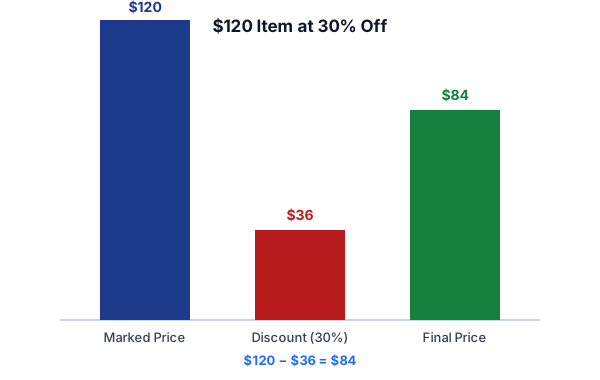
If MP = $120 and discount = 30%:
SP = 120 × (1 − 0.30) = $84
Discount amount = $36
Why 30% Off + 10% Off Isn't 40% Off
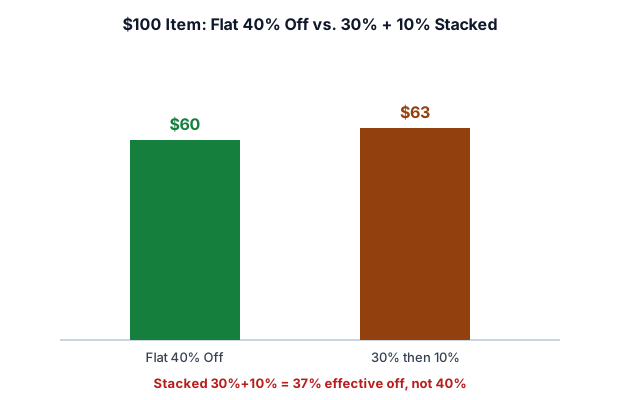
Stacked or successive discounts are one of the most misunderstood parts of shopping math. Each discount applies to the price left over after the previous one, not to the original price — so the discounts don't simply add together.
Stacked Discount Formula: d = d1 + d2 − (d1 × d2 ÷ 100)
For 30% then 10%: d = 30 + 10 − (30 × 10 ÷ 100) = 40 − 3 = 37% effective discount, not 40%.
Percentage Discount vs. Fixed Amount Discount: Which Saves More?
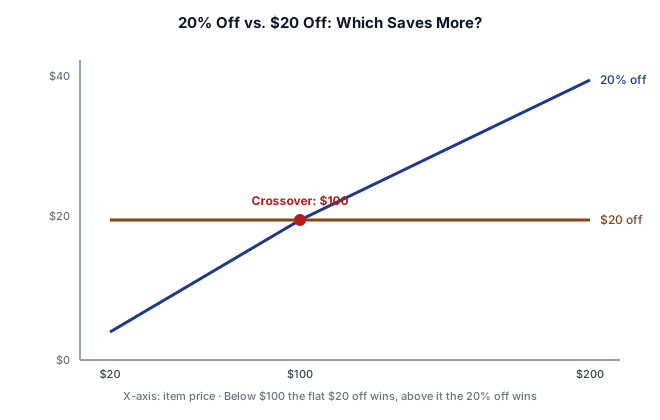
It depends entirely on the item's price. A flat dollar-amount discount and a percentage discount only save the same amount at one specific price — below that price the fixed discount wins, above it the percentage discount wins.
Finding the Original Price from a Sale Price
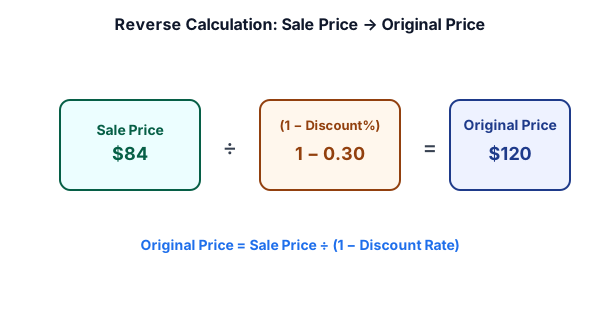
Seeing a sale price and want to know what it cost before the discount? Divide the sale price by (1 − discount rate).
Types of Discounts You Can Calculate Here
- Percentage Discount: the most common type — "20% off" or "50% off." Use the Price After % Discount mode.
- Fixed Amount Discount: a coupon like "$10 off." Use the Price After Fixed Amount Off mode.
- Reverse: Find the Discount %: you know the marked price and sale price and want the percentage. Use Find the Discount %.
- Reverse: Find the Original Price: you know the sale price and discount rate. Use Find the Original Price.
- Stacked / Successive Discounts: "30% off, then an extra 10% off." Use Stacked Discounts to get the true effective rate.
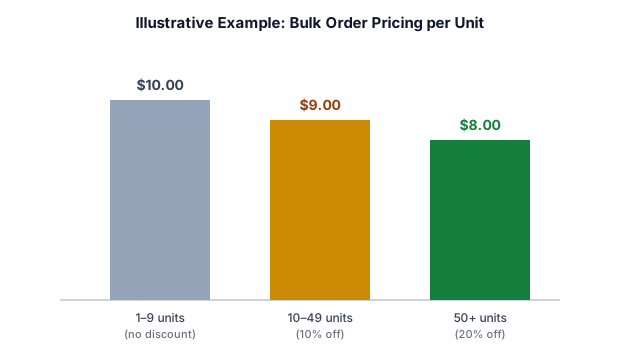
Illustrative Example: Bulk / Tiered Discounts
Businesses often offer bigger discounts for bigger orders. The example below is illustrative — exact tiers vary by vendor — but shows how the same 5 modes above (particularly percentage-off) can be reused at each tier to work out per-unit cost.
Discount vs. Loss
Discount is applied on marked price, while loss is based on cost price. A discount does not always mean a loss — sellers can mark up prices enough that even a discounted sale stays profitable.
Who Uses a Discount Calculator?
Shoppers and Consumers use them during sales events like Black Friday, Eid sales, and end-of-season clearances, or while comparing prices across e-commerce platforms.
Retailers use discount calculators to set competitive pricing, plan promotional campaigns, and calculate margin impact.
Students and Educators use discount calculators to understand percentage concepts in real-world contexts.
Freelancers and Service Providers use them when offering early-payment or package discounts while keeping a healthy margin.
Finance and Procurement Teams rely on discount math when negotiating supplier pricing or evaluating volume purchase agreements.
How to Use This Calculator
- Pick a calculation type from the dropdown.
- Fill in the fields shown for that mode.
- Click Calculate.
- Read your result and the live chart below the button.
Frequently Asked Questions
How do you calculate a discount?
Discount = Marked Price × Discount Percentage ÷ 100. Subtract that from the marked price to get the final selling price.
Does 30% off plus 10% off equal 40% off?
No. Stacked discounts compound: the second discount applies to the already-reduced price, so 30% off followed by 10% off equals an effective 37% off, not 40%.
How do I find the original price from a sale price?
Original Price = Sale Price ÷ (1 − Discount Rate). For example, an $84 sale price after a 30% discount means the original price was $84 ÷ 0.70 = $120.
Is a percentage discount always better than a fixed amount discount?
No. It depends on the item price. Below the price where they're equal, a fixed amount discount saves more; above that price, the percentage discount saves more.
What is the difference between discount and loss?
Discount is calculated on the marked price shown to customers, while loss is calculated against the seller's cost price. A discounted sale can still be profitable if the marked-up price was high enough.