What Is a Concrete Calculator?
A Concrete Calculator is a construction tool designed to help you estimate the amount of concrete needed for your project. By entering details such as:
- Project shape (slab, cylinder, footing)
- Dimensions (length, width, height, or diameter)
- Concrete bag size (e.g., 60 lb, 80 lb)
- Unit system (US feet/inches or metric meters/cm)
…the calculator instantly shows you the concrete volume required and the number of bags needed for your project. If you're mixing your own concrete from raw materials instead of buying premixed bags, the Mix Ratio section below the calculator converts that same volume into cement, sand, and aggregate quantities.
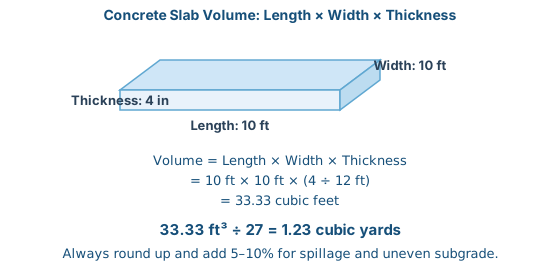
Calculating Slab Volume: A Worked Example
The formula for any slab is simple: length × width × thickness. Here's what that looks like for a common 10 ft × 10 ft patio slab poured 4 inches thick:
Why Use a Concrete Calculator?
- Plan Your Project – Know exactly how much concrete to purchase before starting construction.
- Reduce Waste – Avoid buying excess concrete and save money.
- Ensure Accuracy – Quickly calculate volumes for slabs, footings, or cylindrical structures.
- Make Efficient Decisions – Determine the right bag size and quantity for your project.
How to Use Our Concrete Calculator
- Select the unit system (US or metric).
- Choose the shape of your project (slab, cylinder, or footing).
- Enter the required dimensions (length, width, height, or diameter).
- Select the concrete bag size you plan to use (60 lb or 80 lb).
- Click Calculate to see the concrete volume and number of bags needed.
- Optional: pick a mix ratio below and click Calculate Materials for a raw cement/sand/aggregate breakdown of that same volume.
Premixed Bags: How Many Do You Actually Need?
Premixed bags are rated by how much finished concrete they yield once mixed with water — not by their dry weight alone. Here's how far one cubic yard stretches across the common bag sizes:
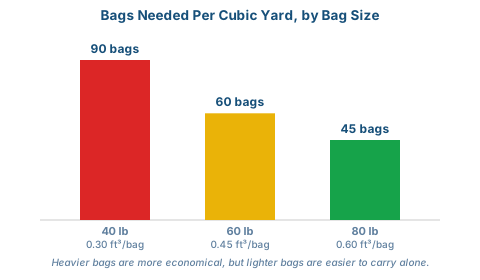
The 80 lb bag is the most economical per cubic yard, but 60 lb bags are considerably easier to lift and carry solo — a real tradeoff worth weighing before you buy a truckload.
Mixing Your Own Concrete: Cement, Sand & Aggregate Ratios
If you're mixing concrete from raw materials instead of premixed bags, the calculation works differently. You first convert your wet concrete volume into a "dry volume" — because loose cement, sand, and aggregate contain air voids that get filled once mixed with water. The standard site-estimation factor for this is 1.54 (1.54 cubic feet of dry material produces roughly 1 cubic foot of finished concrete).
Once you have the dry volume, you split it according to your chosen mix ratio. For a 1:2:4 mix (1 part cement, 2 parts sand, 4 parts aggregate), total parts = 7, so cement gets 1/7 of the dry volume, sand gets 2/7, and aggregate gets 4/7.
Using the same 10 ft × 10 ft, 4-inch slab from above (33.33 ft³ wet, 51.33 ft³ dry), here's how the material split changes across three common ratios:
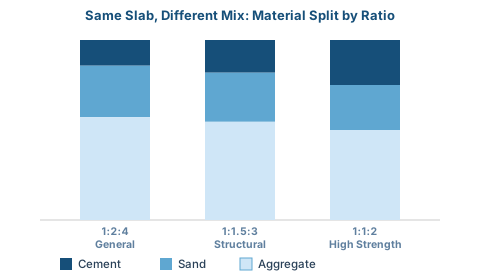
A richer mix (more cement relative to aggregate) produces higher-strength concrete but costs more — 1:1:2 needs nearly twice the cement of 1:2:4 for the exact same slab. Nominal ratios like these are a practical estimation shorthand; for structural work, follow your project's actual engineered mix design.
Standard assumptions: dry volume factor 1.54; cement ≈ 94 lb/ft³ (one standard 94 lb bag ≈ 1 ft³); sand ≈ 105 lb/ft³; aggregate ≈ 100 lb/ft³.
Slab Thickness Guide: How Much Do Common Projects Need?
Thickness has an outsized effect on how much concrete you'll need — doubling it roughly doubles your material cost. Here's the volume needed per 100 square feet at common thicknesses:
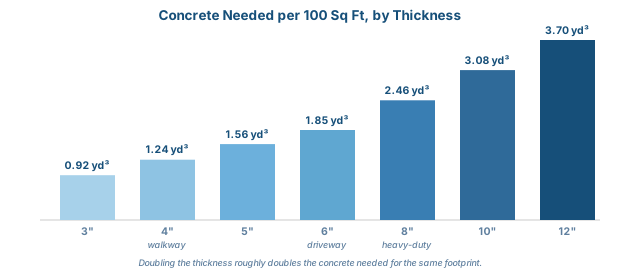
A standard walkway or patio typically runs 4 inches thick; driveways are usually poured at 6 inches to handle vehicle weight; anything supporting heavy equipment or commercial traffic often goes to 8 inches or beyond.
Post Holes and Footings: A Different Shape, Same Math
Round post holes and pier footings use a cylinder formula instead of the slab formula: volume = π × radius² × depth. Here's a typical fence-post example:
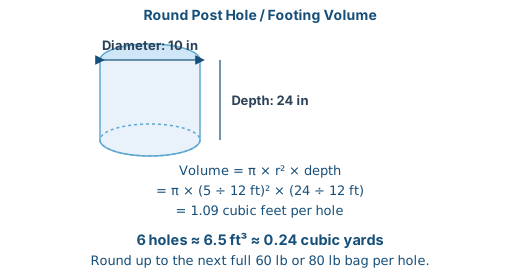
Multiply that per-hole volume by however many posts your project needs — six typical fence post holes like this one add up to only about a quarter of a cubic yard, well within range of a few premixed bags rather than a full truck order.
Tips for Accurate Concrete Estimation
- Include a Waste Allowance – Add ~5–10% extra to account for spillage or uneven surfaces.
- Measure Carefully – Ensure all dimensions are accurate for precise calculations.
- Choose the Right Bag Size – Larger bags may reduce the number of trips but consider handling ease.
- Check Unit Consistency – Ensure all inputs are in the same measurement system (US or metric).
- Know When to Order Ready-Mix – For pours over roughly 1.5–2 cubic yards, a ready-mix truck is often more practical than dozens of individual bags.
Frequently Asked Questions (FAQs)
A Concrete Calculator is an online tool that helps you estimate the amount of concrete needed for your construction project based on dimensions such as length, width, and depth.
Select your unit system and shape, enter the measurements of your slab, footing, or cylinder, and choose a bag size. The calculator will show the volume of concrete required and how many bags to buy.
Using a Concrete Calculator helps you avoid underestimating or overestimating materials, saving both time and money on your project.
The calculated volume and bag count are exact for the dimensions entered. We recommend adding 5–10% extra to account for spillage, waste, and uneven subgrade.
Yes. After calculating your volume, use the Mix Ratio section to choose a ratio (such as 1:2:4) and see the cement, sand, and aggregate quantities needed instead of premixed bags.
Yes, our Concrete Calculator is completely free and can be used online anytime without registration.
Final Thoughts
A Concrete Calculator is an essential tool for builders, DIY enthusiasts, and contractors. It simplifies concrete estimation, prevents material waste, and helps plan projects efficiently — whether you're buying premixed bags or mixing your own from raw cement, sand, and aggregate.
👉 Try our Concrete Calculator today and get accurate results for your construction needs!