Compound Interest Formula with Examples
Last updated August 5, 2026
What Is Compound Interest?
Compound interest is interest calculated on both the original principal and the interest already earned in previous periods. Unlike simple interest, which is calculated only on the principal, compound interest grows faster because you earn interest on top of interest.
This effect is often called the "power of compounding." Over time, even a small interest rate can turn a modest investment into a large sum — which is why compound interest is the foundation of long-term savings, investments, and retirement planning.
For example, if you invest $1,000 at 10% annual compound interest, after year one you earn $100. But in year two, you earn interest on $1,100 — not just $1,000. Each year, the base amount grows, and so does the interest.
Warren Buffett once described compound interest as one of the most powerful forces in finance — and the math proves it.
The Compound Interest Formula
The standard formula for compound interest is:
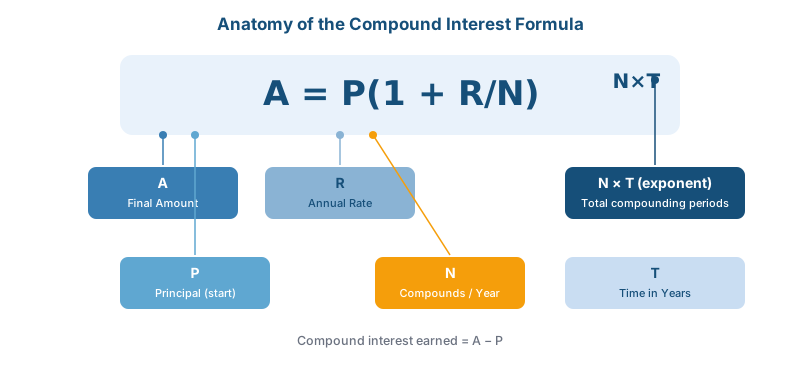
A = P (1 + R/N) ^ (N × T)
Where:
- A = Final amount (principal + interest)
- P = Principal (original amount invested or borrowed)
- R = Annual interest rate (in decimal form — divide percentage by 100)
- N = Number of times interest is compounded per year
- T = Time in years
To find only the compound interest earned (not the total amount):
CI = A − P
Or written fully:
CI = P (1 + R/N) ^ (N × T) − P
Compounding Frequency Table
The value of N changes depending on how often interest is compounded:
| Compounding Frequency | Value of N |
|---|---|
| Annually | 1 |
| Semi-Annually | 2 |
| Quarterly | 4 |
| Monthly | 12 |
| Daily | 365 |
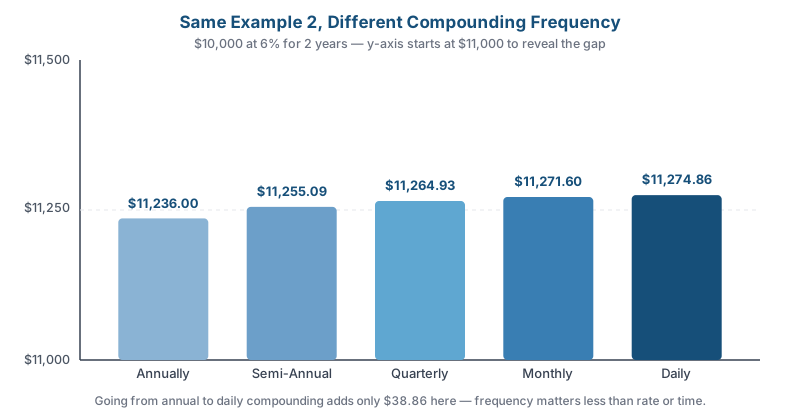
The more frequently interest is compounded, the more interest you earn over the same period — though as the chart below shows, the effect is smaller than most people expect.
Step-by-Step Examples
Example 1 — Compound Interest Compounded Annually
Problem: Find the compound interest on $5,000 at an annual interest rate of 8% for 3 years, compounded annually.
P = 5000, R = 8% = 0.08, N = 1, T = 3
A = 5000 × (1 + 0.08/1) ^ (1 × 3)
A = 5000 × (1.08) ^ 3
A = 5000 × 1.259712
A = $6,298.56
CI = A − P = 6298.56 − 5000
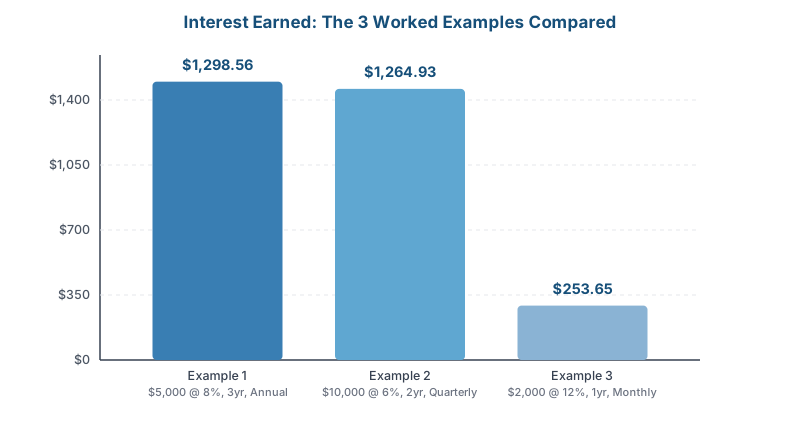
Answer: CI = $1,298.56
Example 2 — Compound Interest Compounded Quarterly
Problem: Calculate the compound interest on $10,000 at 6% per year for 2 years, compounded quarterly.
P = 10000, R = 6% = 0.06, N = 4, T = 2
A = 10000 × (1 + 0.06/4) ^ (4 × 2)
A = 10000 × (1 + 0.015) ^ 8
A = 10000 × (1.015) ^ 8
A = 10000 × 1.126493
A = $11,264.93
CI = 11264.93 − 10000
Answer: CI = $1,264.93
Example 3 — Compound Interest Compounded Monthly
Problem: A person invests $2,000 at 12% annual interest for 1 year, compounded monthly. What is the total amount?
P = 2000, R = 12% = 0.12, N = 12, T = 1
A = 2000 × (1 + 0.12/12) ^ (12 × 1)
A = 2000 × (1 + 0.01) ^ 12
A = 2000 × (1.01) ^ 12
A = 2000 × 1.126825
A = $2,253.65
CI = 2253.65 − 2000
Answer: CI = $253.65
Example 4 — Finding the Principal
Problem: What principal amount will grow to $8,000 in 2 years at 10% annual interest, compounded annually?
A = 8000, R = 0.10, N = 1, T = 2
P = A / (1 + R/N) ^ (N × T)
P = 8000 / (1.10) ^ 2
P = 8000 / 1.21
Answer: P = $6,611.57
Example 5 — Simple vs Compound Interest Comparison
Problem: Compare simple and compound interest on $5,000 at 10% for 4 years.
Simple Interest:
SI = (5000 × 10 × 4) / 100 = $2,000
Total Amount = $7,000
Compound Interest (annually):
A = 5000 × (1.10) ^ 4
A = 5000 × 1.4641
A = $7,320.50
CI = $2,320.50
| Simple Interest | Compound Interest | |
|---|---|---|
| Interest Earned | $2,000 | $2,320.50 |
| Total Amount | $7,000 | $7,320.50 |
| Difference | $320.50 more with CI | |
Over 4 years, compound interest earns $320.50 more than simple interest on the same principal. Want the full formula and more examples? See our Simple Interest Formula guide.
How Much Does Compounding Frequency Really Matter?
Revisiting Example 2 — $10,000 at 6% for 2 years — here's the final amount at every compounding frequency, side by side:
Continuous Compounding
Continuous compounding is the theoretical limit as N approaches infinity — interest compounding at every possible instant. It uses a different, simpler formula built on Euler's number, e (approximately 2.71828):
A = P × e(R × T)
Worked example: $1,000 invested at 5% annual interest for 10 years, compounded continuously.
P = 1000, R = 0.05, T = 10
A = 1000 × e(0.05 × 10)
A = 1000 × e0.5
A = 1000 × 1.648721
A = $1,648.72
CI = $648.72
In practice, few real accounts compound continuously — but it's a useful ceiling. Daily compounding is already extremely close to the continuous limit, which is why banks rarely bother compounding any more frequently than daily.
Effective Annual Rate (EAR): Nominal Rate vs. Real Return
Banks often advertise a nominal rate — the stated annual percentage before compounding is applied. But if that rate compounds more than once a year, your actual return is higher. That real return is the Effective Annual Rate (EAR):
EAR = (1 + R/N)N − 1
Worked example: A credit card or loan advertises a 12% nominal annual rate, compounded monthly. What's the effective annual rate?
R = 0.12, N = 12
EAR = (1 + 0.12/12)12 − 1
EAR = (1.01)12 − 1
EAR = 1.126825 − 1
EAR = 12.683%
This is why the interest rate you're quoted isn't always the interest rate you actually pay or earn. Always check whether a rate is nominal or effective before comparing two savings accounts or loans — a 12% nominal rate compounded monthly costs more than a 12.5% rate compounded annually.
Common Mistakes When Using the Compound Interest Formula
- Forgetting to convert the rate to a decimal. Using 8 instead of 0.08 for R will produce a wildly wrong result.
- Mismatching N and T units. If N is monthly (12), T must stay in years — don't also convert T to months, or you'll compound twice.
- Using the nominal rate when the effective rate is what's being compared. Two accounts with the same nominal rate but different compounding frequency don't pay the same amount — see the EAR section above.
- Assuming compounding frequency changes the outcome dramatically. As shown above, going from annual to daily compounding usually changes the result by well under 1%. Time and rate matter far more.
- Ignoring taxes and fees. The formula computes gross growth only; real-world taxable accounts and fee-bearing investments will compound at a lower effective rate than the formula predicts.
Compound Interest for Different Periods
When time is given in months
Convert months to years by dividing by 12.
Example: 18 months = 18/12 = 1.5 years
When rate is given per month
Multiply the monthly rate by 12 to get the annual rate, or apply the formula directly with the monthly rate and time in months.
Quick Reference — Compound Interest Formulas
| What to Find | Formula |
|---|---|
| Total Amount | A = P (1 + R/N) ^ (N × T) |
| Compound Interest | CI = A − P |
| Principal | P = A / (1 + R/N) ^ (N × T) |
| Rate (approx) | R = (A/P) ^ (1/T) − 1 |
| Time (approx) | T = log(A/P) / log(1 + R) |
| Continuous Compounding | A = P × e ^ (R × T) |
| Effective Annual Rate | EAR = (1 + R/N) ^ N − 1 |
| Rule of 72 (doubling time, approx) | Years ≈ 72 / (R × 100) |
Related Formulas
Compound interest connects directly to several other important financial and mathematical formulas:
- Simple Interest Formula — The simpler version of interest calculation, calculated only on the principal. Great for short-term loans. [See Simple Interest Formula →]
- Percentage Formula — The interest rate R is a percentage. A clear understanding of percentages is essential. [See Percentage Formula →]
- Profit and Loss Formula — Investment returns and compound growth overlap with profit calculations in business. [See Profit and Loss Formula →]
- Average Formula — Average rate of return over multiple years uses compound growth logic. [See Average Formula →]
- EMI Formula — Monthly loan repayments are calculated using compound interest as their base. [See EMI Formula →]
- Discount Formula — Present value calculations (reverse compounding) are used to find discounted values. [See Discount Formula →]
Related Calculators and Pages
Calculate compound interest instantly with monthly contributions →
Simple Interest Formula with Examples
Frequently Asked Questions (FAQ)
Q1. What is the compound interest formula?
The compound interest formula is: A = P (1 + R/N) ^ (N × T). Where A is the final amount, P is the principal, R is the annual interest rate in decimal, N is the number of compounding periods per year, and T is the time in years. The compound interest earned is CI = A − P.
Q2. What is the difference between simple interest and compound interest?
Simple interest is calculated only on the original principal each period. Compound interest is calculated on the principal plus previously earned interest. This means compound interest grows faster, especially over long periods.
Q3. What are the types of compounding?
Common types include annual, semi-annual, quarterly, monthly, daily, and continuous compounding. More frequent compounding results in slightly more interest earned over the same period.
Q4. Where is compound interest used?
Compound interest is used in savings accounts, fixed deposits, mutual funds, stock market investments, retirement accounts, credit card debt, and mortgage loans. It is the core concept behind long-term wealth building.
Q5. What is continuous compounding?
Continuous compounding is the theoretical limit of compounding frequency, where interest compounds an infinite number of times per year. It uses the formula A = P × e^(R×T), where e is approximately 2.71828.
Q6. What is the effective annual rate and how is it different from the nominal rate?
The nominal rate is the stated annual interest rate before accounting for compounding. The effective annual rate reflects the actual yearly return after compounding is applied, and is always equal to or higher than the nominal rate when compounding occurs more than once a year.
Summary
The compound interest formula — A = P (1 + R/N) ^ (N × T) — is one of the most powerful formulas in finance and mathematics. Unlike simple interest, it grows exponentially because interest is earned on previously accumulated interest.
Understanding compound interest helps you make smarter decisions — whether you are saving for retirement, taking out a loan, or evaluating an investment. Time and rate drive most of the outcome; compounding frequency matters, but far less than people assume.
Pair this knowledge with the simple interest formula, percentage formula, and EMI formula for a complete understanding of financial mathematics — or plug your own numbers into our free Compound Interest Calculator to see the result instantly.