What Is Compound Interest?
Compound interest is interest calculated on both your original principal and the interest that has already accumulated. This is different from simple interest, which is only ever calculated on the original amount. Because each round of interest gets added back to the balance before the next round is calculated, the growth curve isn't a straight line — it bends upward, gently at first and then much more steeply, which is why compounding is often called "interest on interest."
The standard formula for compound interest (with no regular contributions) is:
A = P × (1 + r/n)n×t
Where A is the final amount, P is the principal, r is the annual interest rate (as a decimal), n is the number of times interest compounds per year, and t is the number of years. When you add regular contributions PMT at the end of each compounding period, the formula becomes:
A = P × (1 + r/n)n×t + PMT × [((1 + r/n)n×t − 1) / (r/n)]
This is exactly the formula this calculator uses above.
See It In Action: A $10,000 Deposit Plus $200 a Month
Numbers are easier to trust than formulas. Here's a concrete example: you deposit $10,000 to start, add $200 every month, and earn 7% annual interest compounded monthly for 20 years. Here's exactly what happens to your balance versus what you actually put in:
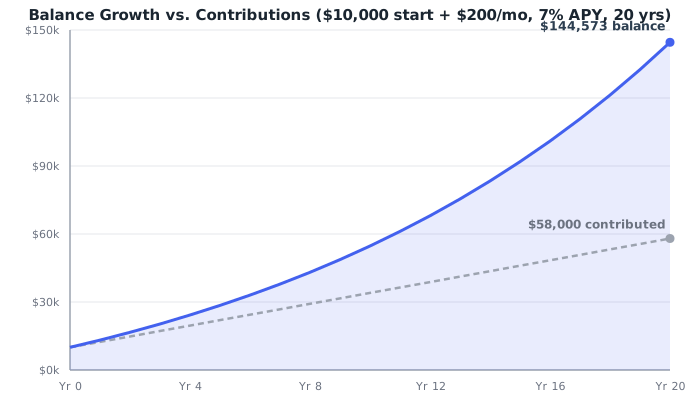
Balance growth vs. contributions: $10,000 initial deposit + $200/month at 7% APY, compounded monthly, over 20 years.
After 20 years, the account holds $144,572.72, even though only $58,000 was ever deposited. The remaining $86,572.72 — nearly 60% of the final balance — is pure compound interest. Notice how the gap between the two lines barely exists in the first few years and then widens dramatically after year 12 or so. That widening gap is compounding doing its job: the more interest you've already earned, the more interest that interest earns.
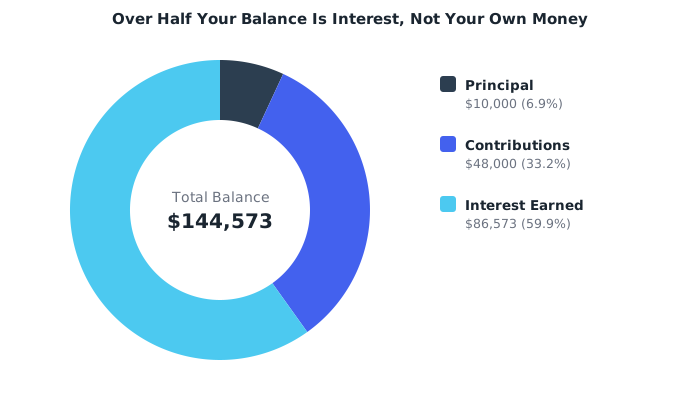
Breakdown of the final $144,573 balance: principal, contributions, and interest earned.
Why Compounding Frequency Matters
For the same rate, more frequent compounding produces a (slightly) higher return, because interest starts earning its own interest sooner. Take a $10,000 deposit at a 6% annual rate for 10 years with no additional contributions:
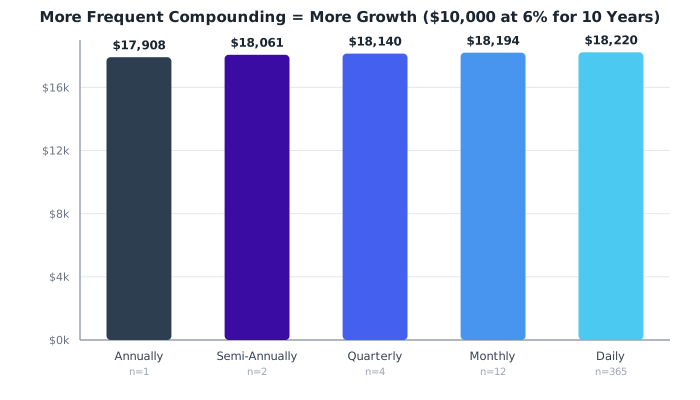
Compounding frequency comparison: $10,000 at 6% for 10 years.
| Compounding Frequency | Periods/Year | Final Balance | Interest Earned |
|---|---|---|---|
| Annually | 1 | $17,908.48 | $7,908.48 |
| Semi-Annually | 2 | $18,061.11 | $8,061.11 |
| Quarterly | 4 | $18,140.18 | $8,140.18 |
| Monthly | 12 | $18,193.97 | $8,193.97 |
| Daily | 365 | $18,220.29 | $8,220.29 |
The jump from annual to daily compounding is worth $311.81 here — real money, but modest compared to the effect of the interest rate itself or how long the money stays invested. In practice, the compounding frequency your bank or broker uses matters far less than starting early and staying consistent.
The Real Lesson: Starting Early Beats Contributing More
This is the single most useful thing compound interest teaches. Compare two investors, both earning 7% annually compounded monthly, both contributing $300 a month:
- Investor A contributes from age 25 to 35 (10 years), then stops and simply lets the balance sit untouched until age 65.
- Investor B waits until 35, then contributes steadily every month all the way to age 65 (30 years).
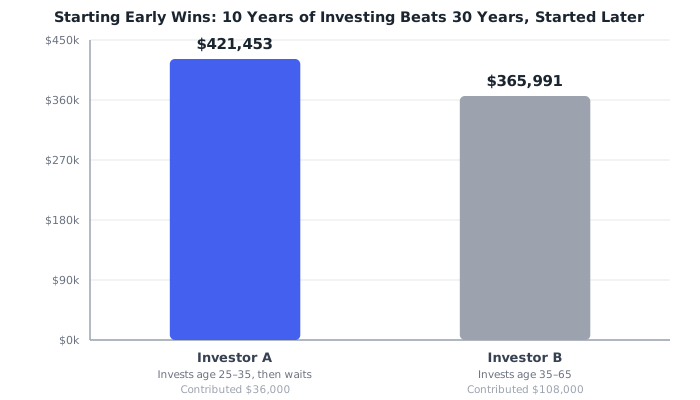
Investor A contributes $36,000 over 10 years starting at 25. Investor B contributes $108,000 over 30 years starting at 35.
Investor A ends up with $421,452.72 after contributing just $36,000 total. Investor B, despite contributing three times as much ($108,000), ends up with only $365,991.30. Investor A comes out more than $55,000 ahead while putting in $72,000 less of their own money — purely because those first 10 years had three extra decades to compound. Time in the market, not the amount you contribute in any given year, is what compound interest rewards most.
The Rule of 72: A Quick Mental Shortcut
Want to estimate how long it takes an investment to double without running a calculator? Divide 72 by your annual interest rate. At 8%, for example, 72 ÷ 8 = 9 years. It's a rough approximation, but it's remarkably close to the actual math:
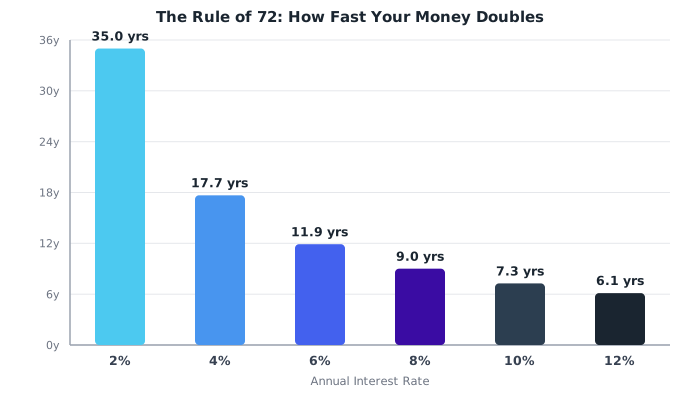
Actual years to double your money at various annual interest rates, calculated precisely.
| Annual Rate | Rule of 72 Estimate | Actual Years to Double |
|---|---|---|
| 2% | 36.0 years | 35.00 years |
| 4% | 18.0 years | 17.67 years |
| 6% | 12.0 years | 11.90 years |
| 8% | 9.0 years | 9.01 years |
| 10% | 7.2 years | 7.27 years |
| 12% | 6.0 years | 6.12 years |
Simple Interest vs. Compound Interest
| Simple Interest | Compound Interest | |
|---|---|---|
| Calculated on | Original principal only | Principal + accumulated interest |
| Growth pattern | Straight line (linear) | Curves upward (exponential) |
| $10,000 at 6% for 10 years | $16,000 | $18,194 (monthly compounding) |
| Common uses | Some auto loans, short-term notes | Savings accounts, CDs, most investments, credit cards |
| Who benefits | Borrowers (less interest owed) | Savers and long-term investors |
Strategies to Get the Most Out of Compound Growth
- Start now, not "eventually." As the early-vs-late comparison above shows, time invested matters more than the size of any single contribution.
- Automate your contributions. Setting up an automatic monthly transfer removes the temptation to skip a month and keeps the compounding curve on schedule.
- Reinvest, don't withdraw. Every dollar of interest you take out early is a dollar that stops compounding for you.
- Compare compounding frequency when it's close. Between two accounts with the same stated rate, daily or monthly compounding will out-earn annual compounding — check the account's APY, not just its stated rate.
- Consider laddering for cash you'll need soon. If you need guaranteed access to part of your money at set dates, splitting funds across CDs with staggered maturity dates (a "CD ladder") can balance growth with liquidity — see our CD Calculator.
Taxes and Insurance: What This Calculator Doesn't Account For
This calculator shows raw, pre-tax growth. In the United States, interest earned in a regular (non-tax-advantaged) savings or investment account is generally taxable as ordinary income in the year it's earned, and your bank will typically issue a Form 1099-INT if you earn $10 or more in a year. Interest earned inside tax-advantaged accounts (like a 401(k), Traditional IRA, or Roth IRA) is treated differently — consult a tax professional for guidance specific to your situation. Separately, bank deposit accounts are typically FDIC-insured up to $250,000 per depositor, per insured bank, per ownership category — a useful ceiling to keep in mind if you're holding a large balance in a single account.
How to Use This Calculator
- Enter your initial principal — the amount you're starting with.
- Optionally enter a regular contribution — the amount you'll add each compounding period (leave at 0 for a one-time deposit).
- Enter your annual interest rate as a percentage.
- Enter the number of years you plan to save or invest.
- Choose your compounding frequency — check your bank or investment statement if you're not sure.
- Click Calculate to instantly see your future value, total contributions, total interest earned, effective annual yield, and how long it would take your money to double at that rate.
Frequently Asked Questions
What is a Compound Interest Calculator?
A Compound Interest Calculator is an online financial tool that estimates how a lump sum, optionally combined with regular contributions, will grow over time when interest is calculated on both the principal and previously earned interest.
How do I use the Compound Interest Calculator?
Enter your principal amount, an optional regular contribution, your annual interest rate, the number of years, and your compounding frequency. The calculator instantly shows your future value, total contributions, and total interest earned.
Why is compound interest important?
Compound interest lets your money grow faster than simple interest because you earn returns on your accumulated interest as well as your original principal, which is why starting early has such an outsized effect on long-term results.
Does compounding frequency make a big difference?
It makes a real but modest difference. In our example, switching a $10,000 deposit at 6% for 10 years from annual to daily compounding added $311.81 — noticeable, but far smaller than the effect of a higher rate or a longer time horizon.
What's the difference between interest rate and APY?
The interest rate is the stated annual rate before compounding is factored in. APY (annual percentage yield) reflects the actual return you'll earn in one year after accounting for how often interest compounds — APY is always equal to or slightly higher than the stated rate.
Is this Compound Interest Calculator free to use?
Yes, this calculator is completely free, requires no signup, and works on both desktop and mobile devices.