What Is a CD Calculator?
A CD (Certificate of Deposit) Calculator is a financial tool that helps you estimate the growth of your savings over time when invested in a CD account. By entering details such as your initial deposit, interest rate, term, and compounding frequency, you can quickly see how much your money will grow.
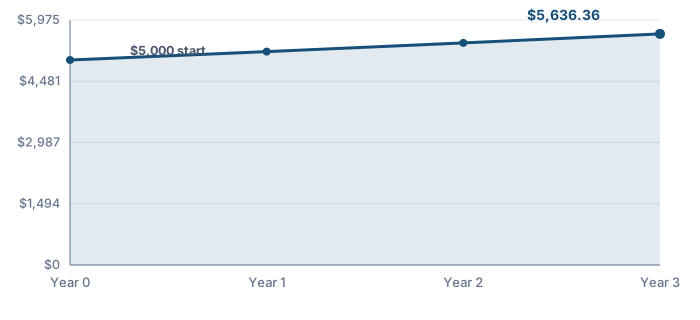
For example, if you deposit $5,000 into a CD with a 4% annual interest rate for 3 years, compounded monthly, the calculator will show your final balance and the total interest earned.
CD Growth Over Time — $5,000 at 4% APY, Monthly Compounding
Key Factors in the Calculator
- Initial Deposit – The amount of money you initially invest in the CD.
- Annual Interest Rate – The percentage your bank pays you yearly.
- Term – The length of time your money stays in the CD (in years).
- Compounding Frequency – How often interest is applied (daily, monthly, quarterly, etc.).
Using these inputs, the calculator instantly computes your final balance and total interest earned.
Nominal Rate vs. APY — Why It Matters
Banks usually advertise CDs using APY (Annual Percentage Yield), not the nominal interest rate. APY already includes the effect of compounding, so it's always equal to or slightly higher than the nominal rate. If your bank quotes an APY directly, enter it as the rate and set compounding to Annually — the calculator will treat it as the true effective yield rather than double-compounding it.
Does Compounding Frequency Actually Matter?
It matters less than most people expect for a typical CD term. Here's the same $5,000 deposit at 4% for 3 years, compared across every compounding frequency a bank might offer:
Total Interest Earned by Compounding Frequency — $5,000 at 4% for 3 Years
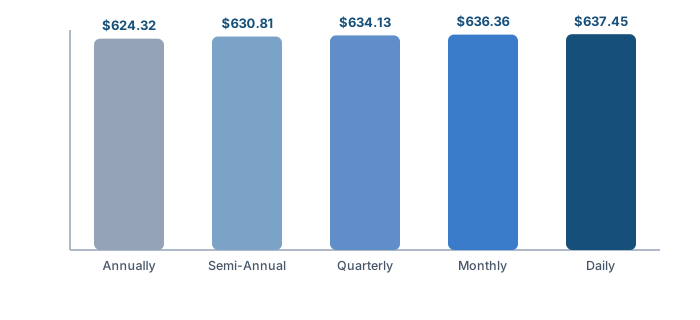
The difference between annual and daily compounding here is just $13.13 over 3 years — worth knowing, but rarely worth choosing one bank over another for this reason alone.
CD vs. High-Yield Savings — How the Growth Compares
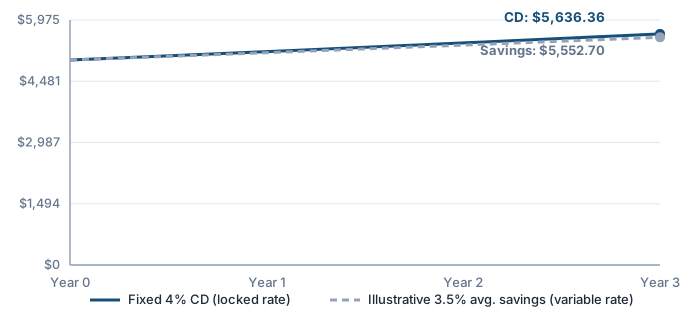
A CD's fixed rate is its biggest advantage: it doesn't move even if market rates fall. A high-yield savings account's rate can (and does) change over time. Here's an illustrative comparison assuming a fixed 4% CD against a savings account averaging 3.5% over the same period — real rates vary by bank and by year, so treat this as an example, not a prediction:
$5,000 Growth: Fixed 4% CD vs. an Illustrative 3.5% Average Savings Rate
Why Use a CD Calculator?
- Plan Your Savings – See exactly how your money grows over time and set realistic financial goals.
- Compare Rates – Test different interest rates or compounding options to maximize earnings.
- Understand Interest – Learn how compounding affects growth and how much interest you will earn.
- Make Confident Decisions – Decide the best term and deposit amount for your savings strategy.
How Does the Calculator Work?
The calculator uses the compound interest formula: A = P (1 + r/n)^(n×t), where:
- P = initial deposit
- r = annual interest rate (decimal)
- n = number of times interest is compounded per year
- t = number of years
It calculates both the total balance at the end of the term and the total interest earned.
How to Use Our CD Calculator
- Enter your initial deposit amount.
- Type in the annual interest rate offered by your bank.
- Enter the term of your CD in years.
- Select the compounding frequency (annually, monthly, daily, etc.).
- Click Calculate to see your final balance and total interest earned.
You'll get an instant view of how much your investment can grow over time with different scenarios.
CD vs. High-Yield Savings Account
CDs aren't the only place to grow cash safely. Here's how they compare to a high-yield savings account:
| Feature | Certificate of Deposit (CD) | High-Yield Savings Account |
|---|---|---|
| Rate | Usually fixed for the term | Variable, can change anytime |
| Access to funds | Locked until maturity | Withdraw anytime |
| Early withdrawal | Usually a penalty (often months of interest) | No penalty |
| Best for | Money you won't need before a set date | Emergency funds, flexible savings |
| Typical insurance | FDIC or NCUA insured up to $250,000 | FDIC or NCUA insured up to $250,000 |
When Should You Use a CD Calculator?
- Planning for Savings Goals – Decide how much to deposit to reach your target.
- Comparing Bank Offers – Compare CDs with different interest rates or compounding frequencies.
- Long-Term Financial Planning – Estimate growth of funds for future needs, like tuition or retirement.
CD Laddering: A Strategy Worth Knowing
Instead of locking all your savings into one CD term, some savers split their money across several CDs with staggered maturity dates — for example, 1-year, 2-year, and 3-year CDs opened at the same time. As each one matures, you either cash it out or roll it into a new long-term CD. This "laddering" approach gives you regular access to part of your money while still capturing the generally higher rates that longer terms tend to offer.
How a 3-Rung CD Ladder Works Over 6 Years
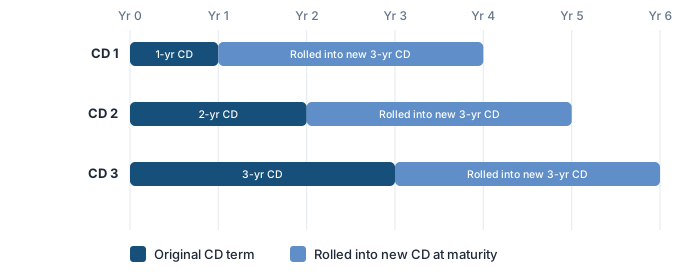
After year 3, one CD matures every single year — giving you regular access to funds while the rest keep earning longer-term rates.
Important Considerations
While CDs are low-risk, remember that your money is locked for the term, and early withdrawals typically incur a penalty — often calculated as a number of months' worth of interest, deducted from what you've earned. Interest earned on a CD is also generally taxable in the year it's earned (even if you don't withdraw it), so U.S. savers should expect a Form 1099-INT from their bank. Always compare interest rates, terms, and compounding options before investing, and confirm your CD is covered by FDIC (banks) or NCUA (credit unions) deposit insurance.
Frequently Asked Questions
What is a CD Calculator?
A CD Calculator is an online tool that helps you estimate the interest and final value of a Certificate of Deposit based on the deposit amount, interest rate, and term length.
How do I use the CD Calculator?
Enter your initial deposit, annual interest rate, term, and compounding frequency. The calculator instantly displays the total interest earned and the maturity value.
Why should I use a CD Calculator?
It helps you compare different CD options, understand your potential earnings, and make better decisions before locking in your money for a fixed term.
Does the CD Calculator include compounding?
Yes. You can choose daily, monthly, quarterly, semi-annual, or annual compounding to see how it affects your total return.
Is the CD Calculator free to use?
Yes, completely free with no registration required, and nothing you enter is stored or sent to a server.
Final Thoughts
A CD Calculator simplifies your savings planning by showing exactly how much your deposit will grow over time. Whether you're saving for short-term goals or long-term investments, this tool gives you a clear financial picture.
👉 Try our CD Calculator now and watch your savings grow with confidence.