What is BMR (Basal Metabolic Rate)?
Basal Metabolic Rate, commonly referred to as BMR, is the number of calories your body requires to maintain basic life functions while at complete rest. These functions include breathing, circulation, cell production, nutrient processing, and temperature regulation — the energy your body burns just to keep you alive, even if you spent the entire day lying in bed without moving.
BMR forms the foundation of your daily calorie needs, typically accounting for 60-75% of total energy expenditure depending on your activity level. Without understanding this baseline, it's difficult to accurately plan a diet, lose weight, or gain muscle.
Think of it like a smartphone's background battery drain: BMR is the percentage used just running background processes, before you've even opened an app. The rest of your daily calorie burn comes from movement on top of that baseline.
Which BMR Formula Should You Use?
This calculator supports three published formulas, each verified against their original source coefficients:
| Formula | Inputs | Best for |
|---|---|---|
| Mifflin-St Jeor (1990) | Weight, height, age, gender | Most people — this is the formula most commonly recommended for the general population today, and the default here. |
| Harris-Benedict (revised 1984) | Weight, height, age, gender | The classic formula; tends to estimate slightly higher than Mifflin-St Jeor for most people. |
| Katch-McArdle | Weight, body fat % | Anyone who knows their body fat percentage — it's based on lean body mass, so it's more accurate for very muscular or very lean people. |
Note: Katch-McArdle doesn't use age or gender at all — it's based entirely on lean body mass, so those fields won't change the result when that formula is selected.
How BMR Differs from TDEE (Total Daily Energy Expenditure)
BMR is the baseline energy your body needs at rest. TDEE adds your activity level — walking, working out, even fidgeting — on top of that baseline. Selecting an activity level above turns your BMR result into a full TDEE estimate.
| Activity level | Multiplier |
|---|---|
| Sedentary (little or no exercise) | × 1.2 |
| Light (exercise 1-3 days/week) | × 1.375 |
| Moderate (exercise 3-5 days/week) | × 1.55 |
| Very active (exercise 6-7 days/week) | × 1.725 |
| Extra active (physical job or 2x/day training) | × 1.9 |
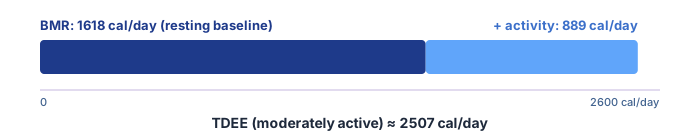
For example: a 30-year-old, 70kg, 170cm male has a Mifflin-St Jeor BMR of about 1,618 calories/day. At a moderate activity level, that becomes a TDEE of roughly 2,507 calories/day.
Why is BMR Important for Health and Fitness?
Understanding your BMR is like knowing your car's fuel efficiency — once you know how much energy your body burns naturally, you can adjust calorie intake and activity to meet your goals, whether that's losing weight, maintaining it, or building muscle.
For weight loss, eating fewer calories than your TDEE creates a deficit, prompting your body to use stored fat for energy. For muscle gain, eating above your TDEE supports building lean mass. Knowing your baseline also helps you avoid drastically under-eating, which can slow metabolism and reduce energy levels over time.
Worked Example Comparison
Different formulas can give meaningfully different numbers for the same person. For a 30-year-old male, 70kg, 170cm, with 20% body fat:
- Mifflin-St Jeor: ~1,618 calories/day
- Harris-Benedict: ~1,672 calories/day
- Katch-McArdle: ~1,580 calories/day
None of these is "wrong" — they're built from different research samples and different inputs. If the numbers you get seem off, try comparing formulas rather than assuming the calculator made an error.