What is a Calorie Deficit?
A calorie deficit occurs when the energy you use (calories out) exceeds the energy you take in (calories in). Energy balance is the thermostat for body weight: eat more than you burn and weight tends to increase; burn more than you eat and weight tends to decrease.
BMR and TDEE Explained
Your BMR (Basal Metabolic Rate) is the number of calories your body burns at complete rest just to keep your organs functioning. This calculator uses the Mifflin–St Jeor equation, generally considered one of the most accurate BMR formulas for the general population:
Men: BMR = 10 × weight(kg) + 6.25 × height(cm) − 5 × age + 5
Women: BMR = 10 × weight(kg) + 6.25 × height(cm) − 5 × age − 161
Your TDEE (Total Daily Energy Expenditure), shown here as "Maintenance Calories," multiplies your BMR by an activity factor to estimate how many calories you burn in a typical day including movement and exercise. Eating below your TDEE creates the deficit that leads to weight loss.
How Big Should Your Calorie Deficit Be?
| Deficit Level | Daily Deficit | Approx. Weekly Loss | Best For |
|---|---|---|---|
| Mild | −250 kcal/day | ~0.25 kg (0.5 lb) | Slow, highly sustainable loss; easier to maintain long-term |
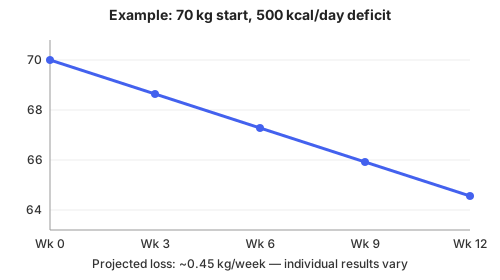
| Moderate | −500 kcal/day | ~0.45 kg (1 lb) | The most commonly recommended starting point |
| Aggressive | −750 kcal/day | ~0.7 kg (1.5 lb) | Faster progress, but harder to sustain and more likely to affect energy levels |
| Very Aggressive | −1000 kcal/day | ~0.9 kg (2 lb) | Generally only appropriate short-term and under medical guidance |
Weekly loss estimates use the common approximation of about 7,700 kcal per kg of body fat (roughly 3,500 kcal per pound). This is a useful planning heuristic, not an exact law — actual results vary by individual.
Safe Calorie Deficit Guidelines
Cutting calories too aggressively tends to backfire: it can slow your metabolism, increase muscle loss alongside fat loss, and make the deficit hard to sustain, often leading to regaining the weight afterward. As general public-health guidance (not individualized medical advice), many health authorities suggest not eating below roughly 1,200 calories/day for women or 1,500 calories/day for men without medical supervision. If your calculated target falls below that, this calculator will flag it — consider a smaller deficit, more activity to widen the gap safely, or professional guidance instead of cutting food intake further.
How accurate are calorie deficit calculators?
They are estimates — good for starting points. BMR formulas and activity multipliers provide reasonable approximations for most people, but individual variation (metabolism, hormones, measurement error in food tracking) means results will differ. Reassess every few weeks and adjust based on real progress rather than the number alone.
How to Use This Calculator
Using our calculator is simple:
- Enter your age
- Select your gender
- Enter your weight and height
- Select your activity level
- Choose a weight loss goal (or enter a custom deficit)
- Click Calculate to see your BMR, maintenance calories, daily target, and a 12-week projection
Beyond Calories: What Actually Helps
- Protein intake: Higher protein helps preserve muscle mass during a deficit and supports fullness.
- Strength training: Resistance exercise helps ensure more of the weight lost is fat rather than muscle.
- Consistency over perfection: A moderate deficit followed consistently usually beats an aggressive one abandoned after two weeks.
- Sleep and stress: Both affect hunger hormones and can make a deficit feel much harder to sustain than the math alone suggests.
Frequently Asked Questions
What is a Calorie Deficit Calculator?
A Calorie Deficit Calculator is an online tool that helps you estimate how many calories you should consume daily to lose weight by creating a calorie deficit based on your age, weight, height, activity level, and goal.
How do I use the Calorie Deficit Calculator?
Enter your age, gender, height, weight, and activity level, then choose a weight loss goal (mild, moderate, aggressive, or a custom deficit). The calculator shows your BMR, maintenance calories, daily calorie target, and a 12-week weight projection chart.
Why is a calorie deficit important for weight loss?
A calorie deficit means you're consuming fewer calories than your body burns, which causes your body to use stored fat for energy, resulting in weight loss over time.
Is the Calorie Deficit Calculator accurate?
It provides a reliable estimate based on established formulas like Mifflin–St Jeor BMR and TDEE. Results may vary depending on individual metabolism, hormones, and lifestyle factors, so treat it as a starting point to adjust from.
How big a deficit is safe?
A moderate deficit of around 500 kcal/day is the most commonly recommended starting point. Very low calorie targets (below roughly 1,200 kcal/day for women or 1,500 kcal/day for men) generally require medical supervision.
Is the Calorie Deficit Calculator free?
Yes, our Calorie Deficit Calculator is completely free to use and accessible on all devices without registration.
At The End
A calorie deficit calculator is a practical tool that translates your age, sex, size, and activity into actionable daily calorie targets. The Mifflin–St Jeor equation plus an activity multiplier gives a good starting TDEE estimate. From there, choose a safe deficit (commonly around −500 kcal/day for moderate loss) and prioritize protein, strength training, and nutrient-dense foods. Expect variability: the 3,500-kcal-per-pound rule is a useful heuristic but not an iron law — metabolism adapts. Recalculate as you progress, track trends over weeks, and prioritize sustainable habits over crash diets.