What is a Calorie?
A calorie is simply a unit of energy — the energy your body gets from food and uses to fuel everything from breathing to sprinting. Nutrition labels actually list kilocalories (kcal), but most people say "calories" and mean the same thing. Understanding calories helps you balance the energy you take in (food and drink) with the energy you burn (your body plus activity).
Why does that matter? Because weight change is largely driven by energy balance: if you consume more energy than you use, you tend to gain weight; if you consume less, your body draws on stored energy (fat or muscle) and you tend to lose weight. However, calories aren't the whole story — nutrition quality, hormones, genetics, sleep, and stress all play roles too.
Which Formula Does This Calculator Use?
This calculator uses the Mifflin–St Jeor equation to estimate your Basal Metabolic Rate (BMR) — the calories your body burns at complete rest:
Men: BMR = 10 × weight(kg) + 6.25 × height(cm) − 5 × age + 5
Women: BMR = 10 × weight(kg) + 6.25 × height(cm) − 5 × age − 161
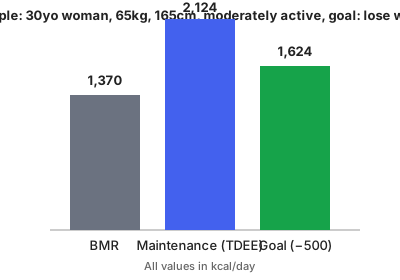
There are older formulas still in use elsewhere — the original Harris-Benedict equation (1919, revised 1984) and the Katch-McArdle formula, which uses lean body mass instead of total weight and is popular with lifters who know their body fat percentage. Mifflin–St Jeor is generally considered the most accurate for the general population in modern validation studies, which is why it's the default here. Your BMR is then multiplied by an activity factor to estimate your TDEE (Total Daily Energy Expenditure) — shown as "Maintenance" in your results — and adjusted up or down based on your goal.
How Much Does Activity Level Actually Matter?
Two people can share the exact same BMR and end up with very different calorie needs, purely based on how active they are. The activity multiplier is often the single biggest lever in this calculator — bigger than most people expect.
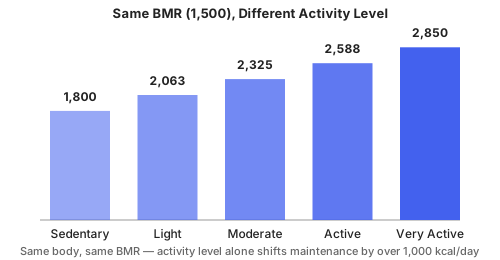
This is also why honesty on the activity level field matters more than precision anywhere else in the form: overestimating your activity level is the most common reason people find they aren't losing weight at their calculated "deficit."
From Calories to Macros
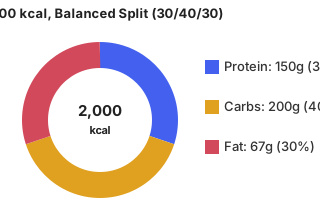
A calorie target alone doesn't tell you what to eat. Once you have your daily number, splitting it into protein, carbohydrates, and fat makes it actionable. Select a Macro Split above and calculate to see your target grams of each:
- Balanced (30/40/30): A reasonable default for general health and moderate activity.
- Higher Protein (40/30/30): Favored during a calorie deficit, since higher protein helps preserve muscle mass while losing fat.
- Lower Carb (35/25/40): A common approach for people who find they feel fuller on more fat and protein relative to carbohydrates.
Protein and carbohydrates provide about 4 calories per gram, while fat provides about 9 calories per gram — which is why the same percentage split still results in very different gram totals across macros.
Daily Calorie Needs by Age, Gender & Activity Level
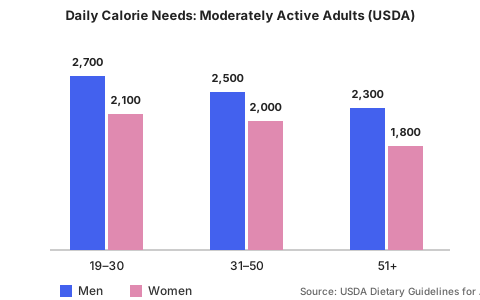
If you want a quick sanity check on your result, here's how typical daily calorie needs break down according to the USDA Dietary Guidelines for Americans, for adults at a healthy reference weight:
| Age Group | Activity | Men | Women |
|---|---|---|---|
| 19–30 | Sedentary | ~2,400 | ~1,800–2,000 |
| 19–30 | Moderately Active | ~2,600–2,800 | ~2,000–2,200 |
| 19–30 | Active | ~3,000 | ~2,400 |
| 31–50 | Sedentary | ~2,200 | ~1,800 |
| 31–50 | Moderately Active | ~2,400–2,600 | ~2,000 |
| 31–50 | Active | ~2,800–3,000 | ~2,200 |
| 51+ | Sedentary | ~2,000 | ~1,600 |
| 51+ | Moderately Active | ~2,200–2,400 | ~1,800 |
| 51+ | Active | ~2,400–2,800 | ~2,000–2,200 |
Source: USDA/HHS Dietary Guidelines for Americans, based on Estimated Energy Requirements (EER) for reference heights and healthy weights. Your personal result above, based on your actual height and weight, will be more precise than this general table — these figures are a useful cross-check, not a replacement.
How Many Calories Do I Need to Gain Weight?
Not everyone using this calculator is trying to lose weight — building muscle requires eating in a surplus. For lean weight gain (maximizing muscle rather than fat), sports nutrition research generally supports a modest surplus of about 200–400 calories above maintenance, paired with resistance training and adequate protein (roughly 1.6–2.2g per kg of body weight). Larger surpluses do add weight faster, but a greater share of it tends to be fat rather than muscle. Select "Gain Weight" above for a starting estimate, then adjust based on how your weight and strength trend over several weeks.
Why Use a Calorie Calculator?
A calorie calculator turns a set of personal details (age, sex, height, weight, activity level) into an estimate of daily calorie needs. Why use one?
- It gives a measurable starting point so you're not guessing.
- It helps set realistic goals — for example, how big a deficit or surplus makes sense for steady progress.
- It informs macronutrient planning — how much protein, carbs, and fat to aim for.
- It helps athletes and lifters plan energy for performance and recovery.
Calculators estimate — they don't measure. If you need clinical precision, such as for pregnancy, a metabolic condition, or elite athletic performance, a registered dietitian can account for factors this calculator can't.
How to Use This Calculator
Using our calorie calculator is simple — enter the following:
- Age — metabolism tends to slow gradually with age.
- Gender — the Mifflin–St Jeor equation uses separate constants for men and women, reflecting average physiological differences; individual results will vary.
- Weight — in kg or lbs.
- Height — in cm or feet/inches.
- Activity level — be honest; overestimating activity is the most common source of inaccurate results.
- Goal — maintain, lose, or gain weight.
Frequently Asked Questions
What is a Calorie Calculator?
A Calorie Calculator is an online tool that estimates the number of calories you need daily to maintain, lose, or gain weight, based on your age, gender, height, weight, and activity level.
How do I use the Calorie Calculator?
Enter your age, gender, weight, height, and activity level, then choose your goal. The calculator shows your BMR, maintenance calories (TDEE), and a goal-adjusted daily calorie target, along with a breakdown chart.
Why should I use a Calorie Calculator?
It helps you track energy intake, plan meals effectively, and work toward your weight goal, whether that's loss, gain, or maintenance, with real numbers instead of guesswork.
Is the Calorie Calculator accurate?
It uses the Mifflin–St Jeor equation, widely considered one of the more accurate BMR formulas for the general population, but actual needs vary with individual metabolism, so treat the result as a starting point to adjust from.
What's the difference between this and the Calorie Deficit Calculator?
This calculator covers all three goals — maintaining, losing, or gaining weight. The Calorie Deficit Calculator focuses specifically on weight loss, with deficit-size presets and a 12-week weight projection chart.
How does the Macro Split feature work?
After calculating your calorie target, choose Balanced, Higher Protein, or Lower Carb from the Macro Split menu. The calculator converts your goal calories into grams of protein, carbohydrate, and fat using standard calorie-per-gram values, shown as a donut chart.
Is the Calorie Calculator free?
Yes, our Calorie Calculator is completely free and works on desktops, tablets, and smartphones without any sign-up.
At The End
A calorie calculator is a powerful, practical tool — not a magic wand. It gives you a data-driven starting point to plan eating for maintenance, loss, or gain. The keys to success are: choose a reliable equation (Mifflin–St Jeor is a solid default), be honest about activity, track real results, prioritize protein and nutrient-dense foods, and adjust based on trends rather than daily noise. If you're in a special situation — pregnancy, illness, or elite athletic training — or you struggle with restrictive habits, consult a qualified clinician or dietitian.