What Is Body Fat Percentage?
Body fat percentage is the proportion of your total body weight that is composed of fat tissue. Unlike weight alone, it tells you how much of your body is functional mass (muscle, bone, organs, water) versus fat storage.
Two people can weigh the same yet have completely different health profiles. A person at 12% body fat is very different from one at the same weight but 30% body fat. That's why body fat percentage is considered far more meaningful than weight or even BMI by fitness and medical professionals.
Essential Fat vs. Storage Fat
Not all body fat is bad. Essential fat is required for normal bodily functions — hormone production, vitamin absorption, brain health, and insulation. Men need a minimum of roughly 2–5% and women roughly 10–13% to sustain normal function.
Storage fat accumulates in adipose tissue and is used as an energy reserve. Moderate amounts are healthy, but excess storage fat — especially visceral fat around organs — raises the risk of cardiovascular disease, type 2 diabetes, and metabolic syndrome.
How This Calculator Works: The U.S. Navy Method
This calculator uses the US Navy Body Fat Method, developed by Hodgdon and Beckett (1984) and widely used by the military, fitness professionals, and researchers.
Women: BF% = 495 ÷ (1.29579 − 0.35004 × log₁₀(waist + hip − neck) + 0.22100 × log₁₀(height)) − 450
All measurements are converted to inches internally before the formula runs, since that's the unit the original 1984 research was calibrated in — enter cm or inches above and the calculator handles the conversion automatically.
Worked Example
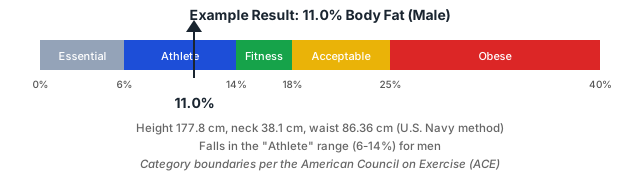
A man measuring 177.8 cm tall, with a 38.1 cm neck and 86.36 cm waist:
Why We Use This Method
- No special equipment needed — just a measuring tape
- Accuracy within roughly 3–4% of DEXA scan results
- Validated across diverse populations
- Used by the US military for official fitness assessments
- Fast and repeatable for tracking progress over time
How to Measure Correctly
- Waist: Measure at the narrowest point, usually around the navel, not the widest part
- Neck: Measure just below the larynx (Adam's apple), sloping slightly downward
- Hips (women): Measure at the widest point across the buttocks
- Take measurements in the morning before eating
- Keep the tape parallel to the floor and snug but not compressing
Healthy Body Fat Percentage Ranges
Body fat categories vary by gender. Ranges follow the American Council on Exercise (ACE) classification.
Men
| Category | Body Fat % | What It Means |
|---|---|---|
| Essential Fat | 2–5% | Minimum required for survival; not sustainable long-term |
| Athletes | 6–13% | Competitive athletes; high muscle definition visible |
| Fitness | 14–17% | Lean and healthy; some muscle definition |
| Acceptable | 18–24% | Average range; healthy but some excess fat |
| Obese | 25%+ | Increased risk of chronic disease; weight loss advised |
Women
| Category | Body Fat % | What It Means |
|---|---|---|
| Essential Fat | 10–13% | Minimum required; women naturally carry more essential fat |
| Athletes | 14–20% | Competitive athletes; high performance and leanness |
| Fitness | 21–24% | Lean and active; healthy and sustainable |
| Acceptable | 25–31% | Average range; healthy with some stored fat |
| Obese | 32%+ | Elevated health risks; lifestyle changes recommended |
Source: American Council on Exercise (ACE) body fat classification.
How to Reduce Body Fat
Sustainable fat loss requires a combination of caloric deficit, exercise, and lifestyle habits. There's no single shortcut — but there is a clear, evidence-backed path.
1. Create a Caloric Deficit
Fat loss occurs when you burn more calories than you consume. A deficit of 300–500 calories per day leads to approximately 0.3–0.5 kg of fat loss per week — a healthy, maintainable rate.
2. Prioritize Protein
Higher-protein diets (roughly 1.6–2.2g per kg of bodyweight) help preserve lean muscle while in a deficit. Protein also increases satiety, reducing overall calorie intake naturally.
3. Strength Train Regularly
Resistance training builds and maintains muscle mass, which raises your resting metabolic rate. Even 3 sessions per week of compound movements (squats, deadlifts, presses) can meaningfully improve your body composition.
4. Add Cardiovascular Exercise
Cardio increases your total caloric expenditure. Aim for 150+ minutes of moderate-intensity cardio weekly. HIIT (high-intensity interval training) can be especially time-efficient for fat loss.
5. Prioritize Sleep and Manage Stress
Poor sleep elevates cortisol, which promotes fat storage — particularly visceral fat. Chronic stress has a similar effect. Prioritizing 7–9 hours of quality sleep and stress management techniques can have a measurable impact on body composition.
Measurement Tips
- Use a soft tape and measure in the morning before meals for consistent results.
- Stand straight. Don't suck in your stomach — breathe normally and measure at the end of a gentle exhale.
- Track monthly. Weekly fluctuations from water and food don't reflect real fat loss.
- Repeat 3x and use the average for better accuracy.
Frequently Asked Questions (FAQs)
Per the American Council on Exercise, roughly 14–24% is considered fit-to-acceptable for men, and 21–31% for women. Athletes often fall below these ranges, while values above 25% (men) or 32% (women) are classified as obese.
The US Navy Method is accurate within approximately 3–4% of DEXA scan results when measurements are taken correctly. It is one of the most widely validated non-invasive methods and is used for official military fitness assessments.
Every 4–6 weeks is a good frequency. Body fat doesn't change overnight, and measuring too frequently can lead to frustration due to normal fluctuations from water weight, digestion, and hormonal cycles. Monthly measurements give you a clearer picture of progress.
Yes — this is called "normal-weight obesity" or being "skinny fat." Someone can be within a normal BMI range while still having a high body fat percentage and low muscle mass. This condition carries similar health risks to traditional obesity, including insulin resistance and cardiovascular risk.
The gold standard is a DEXA (Dual-Energy X-ray Absorptiometry) scan, which is accurate to within 1–2%. Hydrostatic weighing (underwater weighing) is also very accurate. For home use, the US Navy Method or skinfold calipers (with a trained measurer) offer the best balance of accuracy and convenience.
Yes. As we age, muscle mass naturally declines (sarcopenia) and body fat tends to increase — even if total weight stays the same. This is why staying active with resistance training becomes increasingly important after age 30. Some health guidelines adjust acceptable ranges slightly for older adults.
This calculator provides estimates only and is not a substitute for professional medical advice.