BMI Calculator
Check Your BMI
BMI Calculator – Check Your Body Mass Index Instantly
The evolution of modern clinical diagnostics has necessitated the development of non-invasive, cost-effective, and rapid screening tools to address the global rise of metabolic and cardiovascular disorders. Among these, the BMI Calculator stands as the most widely recognized instrument for assessing weight status relative to height. Originally conceived in the nineteenth century as a statistical curiosity by Adolphe Quetelet, the Body Mass Index (BMI) was formally introduced to the medical lexicon in 1972 by Ancel Keys and has since become a cornerstone of public health surveillance. While BMI serves primarily as an indirect measure of body fat, its strong correlation with adverse health outcomes—including type 2 diabetes, hypertension, and various cancers—makes it an indispensable first-line screening measure for clinicians and individuals alike. In an era characterized by an epidemiological transition toward chronic non-communicable diseases, the ability to calculate BMI online instantly provides users with immediate, actionable data regarding their metabolic trajectory.
The Physiological and Theoretical Framework of Body Mass Index
Body Mass Index is defined as a mathematical ratio of an individual's total body mass to the square of their height. In the clinical context, it functions as a surrogate for adiposity, offering a numerical representation of tissue mass—comprising muscle, bone, and fat—distributed across the human frame. Understanding what BMI represents requires a distinction between screening and diagnosis. As a screening tool, the BMI Calculator identifies individuals who fall outside the statistically "healthy" range, prompting further investigation into their metabolic health through blood pressure monitoring, cholesterol panels, and physical examinations.
The physiological rationale for the index is rooted in the observation that body weight in adults increases in proportion to the square of height. This normalization is essential for maintaining a consistent metric across diverse statures. By squaring the height, the formula minimizes the statistical influence of leg length, which is often greater in taller individuals, and focuses the calculation on the trunk, where the majority of vital organs and metabolically active adipose tissue reside. Although BMI does not directly measure the percentage of body fat, it is moderately to strongly associated with more precise laboratory measures such as dual-energy X-ray absorptiometry (DEXA) and underwater weighing. The utility of the index lies in its simplicity; it requires no specialized equipment beyond a calibrated scale and a stadiometer, making it accessible for routine primary care visits and personal health monitoring.
The Mathematical Foundations of BMI Calculation
The calculation of Body Mass Index is standardized across two primary measurement systems: the International System of Units (Metric) and the United States Customary System (Imperial). A reliable digital BMI Calculator must accommodate both systems to ensure accuracy for a global user base.
The metric formula is the standard utilized by the World Health Organization (WHO) and the majority of international medical bodies. It represents weight in kilograms divided by the square of height in meters.
Conversely, the imperial formula, prevalent in the United States, requires a conversion factor to align the result with the metric standard. This constant, approximately 703, translates pounds per square inch into kilograms per square meter.
The precision of these calculations is paramount. For instance, a minor error in height measurement—such as an inch—can significantly alter the resulting BMI category, potentially leading to a misclassification of risk. Modern digital tools automate this process, allowing users to select their preferred units and receive an instant interpretation based on their biological sex and age.
Operational Protocol for a BMI Calculator
To obtain the most accurate results, users must follow a specific operational sequence when using a BMI Calculator. The interface typically provides two tabs: "Metric Units" and "US Units" to facilitate ease of data entry.
1. Select Measurement System – Ensures the correct mathematical formula is applied to the input data.
2. Enter Biological Age – Critical for pediatric calculations and for contextualizing adult results.
3. Select Biological Sex – Influences body composition analysis, though the basic adult formula is universal.
4. Input Height – Height should be measured without shoes, standing straight against a flat surface.
5. Input Weight – Weight should be recorded using a digital scale, ideally in the morning.
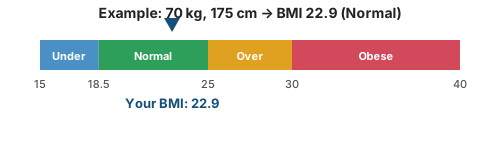
6. Execute Calculation – Clicking the "calculate" button yields the BMI value, its corresponding category, and your position on the visual BMI gauge.
Clinical Classification of BMI Categories
Health organizations categorize BMI values into ranges that reflect varying degrees of health risk. For adults aged 20 and older, these categories are standard regardless of sex or age, providing a clear framework for identifying potential health interventions.
Understanding the Spectrum of Adult Weight Status
The distribution of BMI across a population generally follows a bell curve, but the health implications of these values are distinctly non-linear. The risks associated with chronic disease begin to climb significantly once an individual crosses the threshold from the "healthy" range into "overweight" or "obese" categories.
| BMI Category | BMI Range (kg/m²) | Associated Health Risks |
|---|---|---|
| Underweight | < 18.5 | Malnutrition, anemia, osteoporosis, and impaired immune function. |
| Normal (Healthy) | 18.5 – 24.9 | Lowest overall risk for chronic metabolic and cardiovascular diseases. |
| Overweight | 25.0 – 29.9 | Increased risk of hypertension, type 2 diabetes, and heart disease. |
| Obesity (Class I) | 30.0 – 34.9 | Moderate risk of serious conditions; often requires lifestyle or medical intervention. |
| Obesity (Class II) | 35.0 – 39.9 | High risk of mortality and severe functional limitations. |
| Obesity (Class III) | ≥ 40.0 | Severe or morbid obesity; significantly reduced life expectancy. |
The classification of obesity into three distinct classes allows for a more granular assessment of risk. Class III obesity, often referred to as severe or morbid obesity, is associated with a reduction in life expectancy by 6 to 13 years. In contrast, the underweight category highlights a different set of risks, often overlooked in modern discourse, including increased vulnerability to infections and potential fertility issues in women.
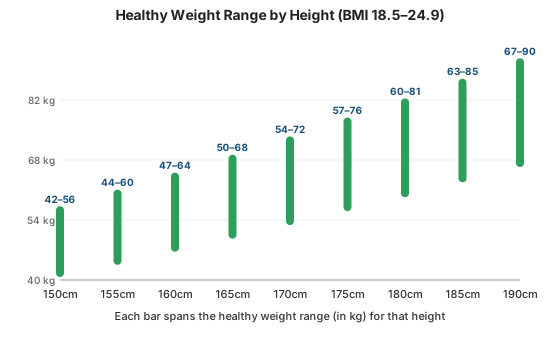
What Should I Weigh for My Height?
BMI ranges are useful, but most people find it easier to think in actual kilograms or pounds rather than a ratio. The chart below translates the standard healthy BMI range (18.5–24.9) into a healthy weight range for a set of common heights.
Pediatric Nuances: BMI-for-Age Percentiles
For children and adolescents between the ages of 2 and 19, the interpretation of BMI is fundamentally different. Because children undergo rapid physiological changes and growth spurts, a single BMI value cannot be compared to a static adult range. Instead, clinicians utilize BMI-for-age percentiles, which compare a child's BMI to a reference population of the same age and biological sex.
| Weight Status Category | Percentile Range |
|---|---|
| Underweight | Less than the 5th percentile |
| Healthy Weight | 5th percentile to less than the 85th percentile |
| Overweight | 85th to less than the 95th percentile |
| Obesity | 95th percentile or higher |
| Severe Obesity | 120% of the 95th percentile or higher |
Annual BMI screening is recommended as a standard component of pediatric care. This tracking is critical for detecting early deviations from healthy growth patterns and for the precise dosing of medications, which are often based on a child's body mass.
The Healthy BMI Range: Physiological Benefits and Lifecycle Variations
The "healthy" BMI range of 18.5 to 24.9 kg/m² is statistically associated with the highest health-related quality of life and the lowest incidence of metabolic syndrome. Maintaining a stable weight within this range supports joint integrity, reduces the mechanical workload on the heart, and maintains optimal hormonal balance.
Impact on Longevity and Mortality
Longitudinal epidemiological studies have consistently demonstrated a direct association between BMI and mortality risk. While a BMI above 25 kg/m² is generally linked to increased cardiovascular risk, some researchers have observed an "obesity paradox" in specific populations, such as the elderly. For adults over the age of 65, the optimal BMI range may shift slightly higher, potentially between 23 and 27 kg/m². This higher range may provide a "metabolic reserve" that protects against frailty and supports recovery during acute illness. However, the consensus among major health bodies like the WHO remains that for the majority of the adult population, the 18.5–24.9 range is the primary target for disease prevention.
Sexual Dimorphism and Body Composition
Although the BMI Calculator uses the same formula for both men and women, the underlying physiological reality is governed by sexual dimorphism. Biological sex influences not only the total percentage of body fat but also its distribution and metabolic impact.
Women typically have a higher percentage of body fat than men at the same BMI level. This is partially due to reproductive requirements; fat stores are essential for ovulation, gestation, and lactation. Estrogen promotes the storage of fat in the subcutaneous layers of the hips and thighs (gynoid or "pear-shaped" distribution), which is generally considered less metabolically harmful.
Men, influenced by testosterone, tend to have higher muscle mass and larger skeletal frames, which can lead to higher results on a BMI Calculator even if body fat is low. Furthermore, men are more predisposed to accumulating visceral fat in the abdominal region (android or "apple-shaped" distribution). This visceral fat is highly active, surrounding internal organs and releasing inflammatory cytokines that increase the risk of heart disease and type 2 diabetes.
The Influence of Ethnicity on BMI Thresholds
One of the most significant advancements in BMI interpretation is the recognition that the relationship between BMI and health risk varies across racial and ethnic groups. Standard BMI categories were originally established based on data from primarily White populations, which may not accurately reflect the risks faced by other groups.
Asian and South Asian Population Risks
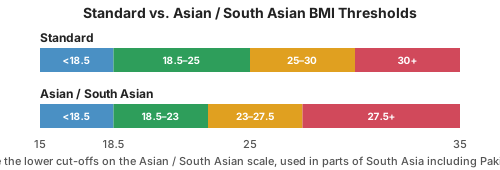
Clinical research has identified that individuals of Asian descent, particularly South Asians — including populations across Pakistan, India, and Bangladesh — exhibit a higher risk for type 2 diabetes and cardiovascular disease at significantly lower BMI levels than White populations. This is often due to a higher percentage of body fat and more central adiposity at any given BMI. Consequently, the WHO and the National Institute for Health and Care Excellence (NICE) have recommended lower BMI thresholds for these populations.
| BMI Category | Standard Threshold | Asian/South Asian Threshold |
|---|---|---|
| Healthy Weight | 18.5 – 24.9 | 18.5 – 22.9 |
| Increased Risk (Overweight) | 25.0 – 29.9 | 23.0 – 27.4 |
| High Risk (Obese) | ≥ 30.0 | ≥ 27.5 |
In South Asian populations, a BMI as low as 23 kg/m² can be an indicator of increased metabolic risk, whereas the same value in a White European would be considered comfortably within the healthy range. These ethnicity-adjusted thresholds are critical for early intervention and precision risk management — and are worth knowing if you're checking your BMI in Pakistan or elsewhere in South Asia, since the standard Western categories alone may understate your risk.
Systemic Benefits of Regular BMI Assessment
The clinical utility of a BMI Calculator extends beyond simple weight categorization. It serves as a vital tool for population health management and individual wellness tracking.
- Detecting Obesity Risk and Comorbidities: High BMI levels are robust predictors of cardiovascular disease, hypertension (1–2 mmHg increase per unit BMI), type 2 diabetes, and musculoskeletal integrity (losing 10 lbs reduces knee pressure by 30–60 lbs).
- Monitoring Fitness and Lifestyle Progress: Trends in BMI provide an objective metric to track progress, though it is important to ensure weight loss comes from fat rather than lean muscle mass.
- Economic and Societal Implications: Obesity-related medical costs in the US were estimated at nearly $173 billion annually in 2019, according to the CDC. Approximately one in three young adults (17–24) are too heavy to serve in the military.
Navigating the Limitations of BMI
While the BMI Calculator is a reliable population screening tool, it possesses inherent limitations that must be understood to avoid clinical misinterpretation.
- The Athlete and Bodybuilder Paradox: Muscle is denser than fat; high-performance athletes may have a "high" BMI despite extremely low body fat.
- Sarcopenia and the Elderly: Older adults may lose muscle and bone density (sarcopenia) while gaining fat, leading to a "healthy" BMI but unhealthy body composition.
- Adipose Tissue Distribution: BMI provides no information about visceral vs. subcutaneous fat. Visceral fat is significantly more dangerous.
Because of these limitations, clinicians often use BMI in conjunction with waist circumference (under 35 inches for women, under 40 inches for men), waist-to-height ratio (less than half of height), and DEXA scans for precise body composition analysis.
Evidence-Based Tips to Maintain a Healthy BMI
Maintaining a healthy BMI is a lifelong journey that involves sustainable changes in nutrition, physical activity, and overall behavior. Research consistently shows that "crash" or "fad" diets are rarely successful in the long term; instead, integrating healthy habits into daily routines is the key to success.
- Nutritional Strategies: Prioritize fiber and whole foods (≥25g naturally occurring fiber daily), balanced protein intake, mindful hydration (6–8 glasses of water daily), and calorie awareness through portion control.
- Physical Activity: WHO/CDC recommends 150–300 minutes of moderate intensity (or 75–150 minutes of vigorous intensity) aerobic activity per week, plus strength training on 2 days.
- Behavioral Factors: Optimize sleep quality (≥7 hours), manage stress to lower cortisol, and use self-monitoring tools like a BMI Calculator to track progress.
Frequently Asked Questions
What is a good BMI for my age?
For adults aged 20+, a healthy BMI is 18.5–24.9. For seniors over 65, a slightly higher range (23–27) may be beneficial for longevity. Always consult a healthcare provider for guidance specific to you.
How accurate is the BMI Calculator in predicting health?
It is a reliable screening indicator of body fatness for most people, but it is not diagnostic. It can misclassify athletes or older adults with low muscle mass. Use it alongside other metrics like waist circumference.
Can children and teenagers use BMI calculators?
Yes, but they must use a BMI-for-age percentile rather than the fixed adult categories (ages 2–19). A healthy weight is generally between the 5th and 85th percentiles for age and sex.
Is the BMI result different for men and women?
The formula is identical, but interpretation should account for biological differences: women naturally carry higher body fat at the same BMI, while men are more prone to visceral (abdominal) fat.
What BMI level is considered obese?
A BMI of 30.0 or higher is classified as obese, further divided into Class I (30–34.9), Class II (35–39.9), and Class III (≥40) on the standard scale.
Why do some ethnicities have different BMI cut-offs?
Asian and South Asian populations tend to have higher visceral fat and health risk at lower BMIs, so thresholds for "overweight" are often lowered to 23 kg/m² and "obese" to 27.5 kg/m² for these groups, including in Pakistan.
Can BMI measure body fat directly?
No. BMI does not measure body fat directly — it's a ratio of weight to height. It correlates reasonably well with body fat at a population level, but methods like DEXA scans are needed for a precise individual measurement.
Why might an athlete have a "high" BMI?
Muscle is denser than fat, so a muscular, low-body-fat athlete can register as "overweight" or even "obese" by BMI alone. This is a well-known limitation of the index, not an error in the calculation.
Conclusion: Strategic Use of the BMI Calculator for Health Optimization
The Body Mass Index serves as a foundational metric in the landscape of preventive medicine. By providing a quick, accessible, and scientifically validated method for categorizing weight status, the BMI Calculator empowers individuals to take a proactive role in their metabolic health. While it is important to acknowledge the limitations of the index—particularly its inability to distinguish between muscle and fat mass or account for fat distribution—its value as a screening tool for identifying cardiovascular and metabolic risk is indisputable.
For the most effective health outcomes, the result obtained from a BMI Calculator should be viewed as a starting point for a broader conversation with a healthcare provider. Integrating BMI tracking with lifestyle modifications, such as following a balanced diet, engaging in regular moderate-to-vigorous physical activity, and prioritizing sleep, can significantly reduce the risk of obesity-related diseases. Whether you are an athlete monitoring body composition or an individual seeking to improve overall well-being, the BMI Calculator tool remains an essential instrument for navigating the complexities of modern health. Users are encouraged to utilize the calculator above regularly to monitor their progress and support a long-term commitment to a healthy weight.