Average Formula with Examples
What Is an Average?
An average is a single number that represents the central or typical value of a group of numbers. It gives you a quick summary of a data set without listing every individual value.
In everyday life, averages are used constantly. A teacher calculates the average score of a class. A business tracks average monthly sales. A cricketer's batting average tells you their typical performance. In each case, the average turns many numbers into one meaningful figure.
The most common type of average in mathematics is the mean, often simply called "the average."
The Basic Average Formula
The formula for calculating the average (arithmetic mean) is:
Average = Sum of All Values / Total Number of Values
Or written more compactly:
Average = ΣX / N
Where:
- ΣX = the sum of all values in the data set
- N = the total count of values
This formula works for any set of numbers — test scores, temperatures, prices, ages, and more.
Step-by-Step Examples
Example 1 — Average of Simple Numbers
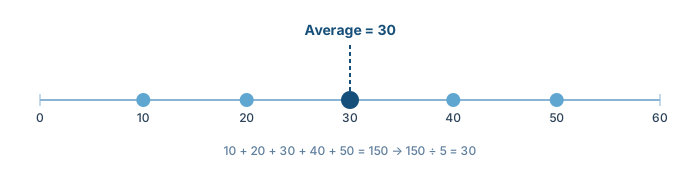
Problem: Find the average of 10, 20, 30, 40, and 50.
Sum = 10 + 20 + 30 + 40 + 50 = 150
Count = 5
Average = 150 / 5
Answer: 30
Example 2 — Average of Exam Scores
Problem: A student scored 72, 85, 90, 68, and 95 in five subjects. What is their average score?
Sum = 72 + 85 + 90 + 68 + 95 = 410
Count = 5
Average = 410 / 5
Answer: 82
Example 3 — Finding a Missing Value Using the Average
Problem: The average of four numbers is 25. Three of the numbers are 20, 28, and 30. What is the fourth number?
Total sum needed = Average × Count = 25 × 4 = 100
Sum of known values = 20 + 28 + 30 = 78
Missing value = 100 − 78
Answer: 22
Example 4 — Average with Decimal Values
Problem: A shopkeeper recorded daily sales of $120.50, $98.75, $145.00, and $110.25 over four days. What is the average daily sale?
Sum = 120.50 + 98.75 + 145.00 + 110.25 = 474.50
Count = 4
Average = 474.50 / 4
Answer: ≈ $118.63 (exactly $118.625)
Weighted Average Formula
A regular average treats all values equally. A weighted average gives different values different levels of importance (called weights).
Weighted Average = Σ(Value × Weight) / Σ Weight
Example — Weighted Average of Grades
Problem: A student's final grade is based on: Assignments (weight 2) scored 80, Midterm (weight 3) scored 70, Final Exam (weight 5) scored 90. What is their weighted average?
Numerator = (80 × 2) + (70 × 3) + (90 × 5) = 160 + 210 + 450 = 820
Denominator = 2 + 3 + 5 = 10
Weighted Average = 820 / 10
Answer: 82
Types of Averages
In mathematics and statistics, there are three main types of averages, collectively called measures of central tendency:
1. Mean (Arithmetic Average)
The most commonly used average. Add all values and divide by the count.
Formula: Mean = Sum / Count
2. Median
The middle value when all numbers are arranged in order. If there is an even count of numbers, the median is the average of the two middle values.
Example: For 3, 7, 9, 12, 15 — the median is 9.
3. Mode
The value that appears most frequently in a data set.
Example: In 4, 6, 6, 7, 9, 9, 9 — the mode is 9.
Each type of average has its own use. The mean is best for evenly distributed data. The median is better when there are extreme outliers. The mode is useful for categorical data.
Quick Reference — Average Formulas
| Type | Formula |
|---|---|
| Arithmetic Mean | Sum of Values / Count of Values |
| Weighted Average | Σ(Value × Weight) / Σ Weight |
| Median (odd count) | Middle value after sorting |
| Median (even count) | (Sum of two middle values) / 2 |
| Mode | Most frequently occurring value |
Related Formulas
The average formula connects closely with many other math and statistics concepts:
- Percentage Formula — Used to express a score or value as a percentage of the total. [See Percentage Formula →]
- Profit and Loss Formula — Average cost and average selling price are key inputs in profit calculations. [See Profit and Loss Formula →]
- Simple Interest Formula — Average principal or rate is often used in financial calculations. [See Simple Interest Formula →]
Related Calculator and Pages
Frequently Asked Questions (FAQ)
Q1. What is the formula for average?
The average formula is: Average = Sum of All Values / Total Number of Values. For example, the average of 10, 20, and 30 is (10 + 20 + 30) / 3 = 20.
Q2. What is the difference between mean, median, and mode?
Mean is the sum divided by the count. Median is the middle value when data is sorted. Mode is the most frequently occurring value. All three are types of averages but suit different data situations.
Q3. How do you find a missing number when the average is known?
Multiply the average by the total count to get the required sum. Then subtract the sum of the known values. The result is the missing number.
Q4. What is a weighted average and when is it used?
A weighted average gives more importance to certain values than others. It is used when values have different levels of significance, such as grading systems, financial portfolios, or survey results. Formula: Σ(Value × Weight) / Σ Weight.
Q5. Can the average be greater than the largest value in a set?
No. The arithmetic mean always falls between the smallest and largest values in a data set. It can never be higher than the maximum or lower than the minimum.
Q6. How is average used in real life?
Averages are used in school grading, weather reporting (average temperature), sports statistics (batting average, goals per game), finance (average income, average returns), and business (average sales per day).
Summary
The average formula — Average = Sum of All Values / Total Number of Values — is one of the most fundamental tools in mathematics. It turns a collection of numbers into a single representative figure. Whether you are working with exam scores, sales data, temperatures, or any other set of values, this formula gives you a clear picture of what is typical.
Beyond the basic mean, understanding weighted averages and the difference between mean, median, and mode gives you a complete toolkit for working with data in school, work, and everyday life.