Kinetic Energy Calculator – Calculate KE, Momentum & Free-Fall Speed Online
Try the Calculator
Note: This calculator gives ideal results based on classical mechanics and ignores air resistance and friction.
Complete Guide to Kinetic Energy
Have you ever wondered why a fast-moving baseball packs such a punch, or why a heavy truck is so much harder to stop than a bicycle? The answer lies in a fundamental concept of physics: kinetic energy.
Whether you are a student tackling a physics homework assignment or an enthusiast curious about the mechanics of the world, understanding how energy and motion interact is essential. This kinetic energy calculator goes beyond a single formula — it also works out momentum and an equivalent free-fall height, so you can see the full physical picture behind your numbers.
What Is Kinetic Energy?
In the simplest terms, kinetic energy is the energy an object possesses due to its motion. If an object is moving, it has kinetic energy. If it is standing perfectly still, its kinetic energy is zero.
The word "kinetic" comes from the Greek word kinesis, which means "motion." In physics, energy is defined as the capacity to do work. Kinetic energy represents the work an object can do because of how fast it is moving and how much mass it has.
The Kinetic Energy Formula Explained
To calculate kinetic energy online or on paper, physicists use a specific mathematical relationship. The kinetic energy equation describes how mass and velocity interact to create total energy.
The standard formula is:
Breaking Down the Variables:
KE: Kinetic Energy (measured in Joules).
m: Mass of the object (measured in kilograms).
v: Velocity (speed) of the object (measured in meters per second).
This formula tells us that kinetic energy is directly proportional to the mass of the object and the square of its velocity. If you double the mass, you double the energy. If you double the velocity, the energy quadruples.
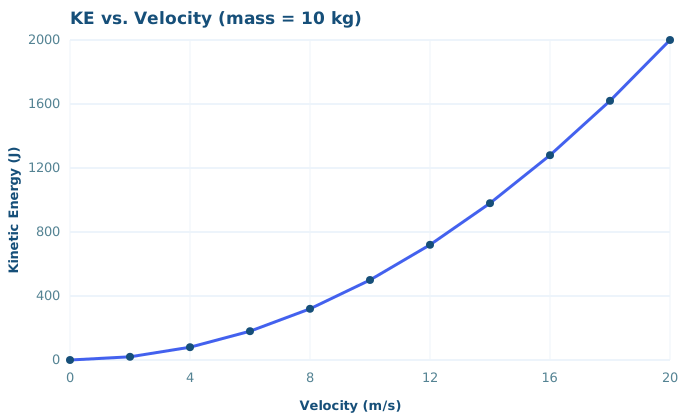
Kinetic energy rises with the square of velocity — this is why the curve bends sharply upward rather than forming a straight line.
Unit Conversions the Calculator Handles
Real-world measurements rarely come in neat kilograms and meters per second. That's why this calculator accepts pounds for mass and km/h, mph, or ft/s for velocity, converting everything internally before applying the formula:
| Quantity | Unit | Conversion to SI |
|---|---|---|
| Mass | Pound (lb) | 1 lb = 0.453592 kg |
| Velocity | Kilometers per hour (km/h) | 1 km/h = 0.277778 m/s |
| Velocity | Miles per hour (mph) | 1 mph = 0.44704 m/s |
| Velocity | Feet per second (ft/s) | 1 ft/s = 0.3048 m/s |
Kinetic Energy vs. Momentum: Why the Calculator Shows Both
Kinetic energy and momentum both describe motion, but they behave differently — which is why this calculator computes momentum (p = m × v) alongside kinetic energy for every result. Momentum grows in direct proportion to velocity, while kinetic energy grows with the square of velocity.
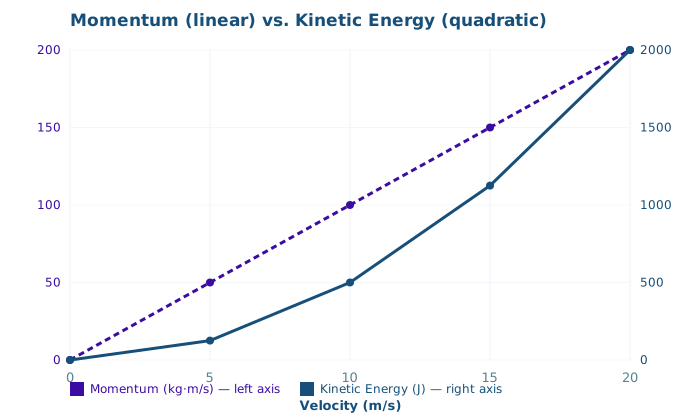
For a 10 kg mass, momentum climbs in a straight line while kinetic energy curves upward — at 20 m/s, momentum is 200 kg·m/s but kinetic energy is 2,000 J.
| Quantity | Formula | Type | Grows With |
|---|---|---|---|
| Momentum | p = m × v | Vector (has direction) | Velocity (linear) |
| Kinetic Energy | KE = ½ m v² | Scalar (no direction) | Velocity squared |
How the Kinetic Energy Calculator Works
This energy calculator physics tool handles the heavy lifting for you. Here is what happens behind the scenes when you use it:
- Input: Mass (m): Enter the weight of the object in kilograms or pounds — the calculator converts pounds automatically.
- Input: Velocity (v): Enter the speed in m/s, km/h, mph, or ft/s. The calculator converts everything to meters per second internally.
- Output: Energy, Momentum & Free-Fall Equivalent: The tool returns kinetic energy in Joules, momentum in kg·m/s, and the height an object would need to fall from (under gravity alone) to reach the same speed.
Step-by-Step Guide: How to Use This Calculator
- Identify your values: Find the mass of your object and its current speed.
- Enter the mass: Type the mass and pick kg or lb.
- Enter the velocity: Type the speed and pick m/s, km/h, mph, or ft/s.
- Click "Calculate": The tool instantly processes the kinetic energy equation.
- Review your results: See kinetic energy, momentum, and the equivalent free-fall height.
Real-Life Examples of Kinetic Energy
Physics isn't just symbols on a chalkboard — it's happening all around you. Here are precise kinetic energy examples using everyday masses and speeds:
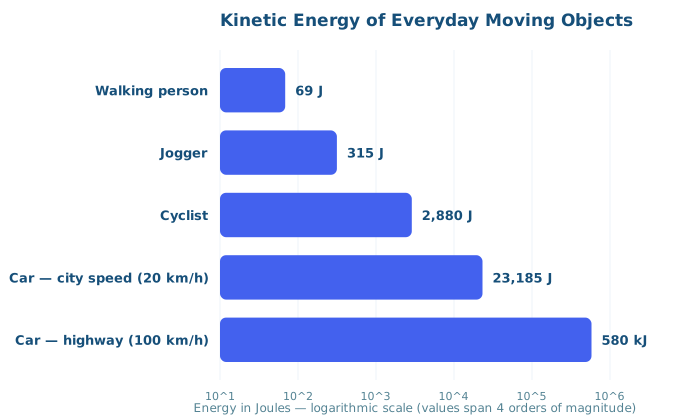
Because these values span four orders of magnitude, the chart uses a logarithmic scale — each gridline is 10 times larger than the one before it.
| Scenario | Mass | Speed | Kinetic Energy |
|---|---|---|---|
| Walking person | 70 kg | 1.4 m/s (~5 km/h) | 68.6 J |
| Jogger | 70 kg | 3.0 m/s (~10.8 km/h) | 315 J |
| Cyclist | 90 kg (rider + bike) | 8.0 m/s (~29 km/h) | 2,880 J |
| Car at city speed | 1,500 kg | 5.56 m/s (20 km/h) | 23,185 J |
| Car at highway speed | 1,500 kg | 27.8 m/s (100 km/h) | 579,630 J |
Units of Kinetic Energy: Joules Explained
In the International System of Units (SI), the unit for energy is the Joule (J). One Joule is the energy exerted when a force of one Newton is applied over a displacement of one meter — roughly the energy needed to lift a small apple one meter straight up.
For larger objects like cars or airplanes, energy is often expressed in Kilojoules (kJ) or Megajoules (MJ):
- 1 kJ = 1,000 Joules
- 1 MJ = 1,000,000 Joules
Factors That Affect Kinetic Energy
Two main factors dictate how much energy a moving object has.
The Role of Mass
Mass is a measure of how much "stuff" is in an object. If two objects move at the same speed, the heavier one always has more kinetic energy — this is why a bowling ball does more damage to pins than a tennis ball thrown at the same speed.
The Power of Velocity
Velocity is squared in the formula, which makes it the most influential factor. Many people find it surprising that speed matters more than weight:
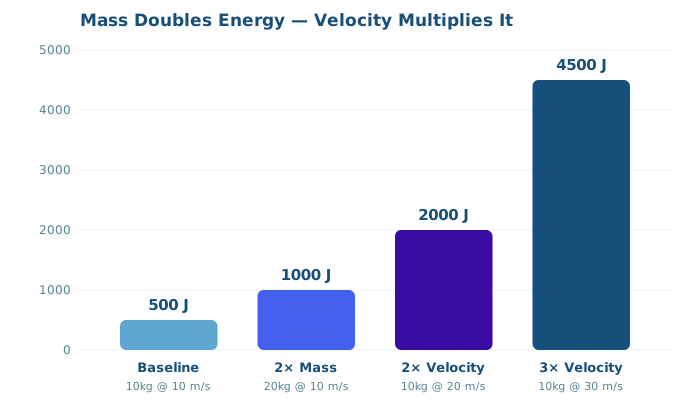
Starting from 500 J: doubling the mass raises energy to 1,000 J, but doubling the velocity raises it to 2,000 J — and tripling the velocity raises it to 4,500 J.
- Double the mass → kinetic energy doubles (2×).
- Double the speed → kinetic energy increases fourfold (2² = 4×).
- Triple the speed → kinetic energy increases ninefold (3² = 9×).
This is why high-speed collisions are so much more dangerous than low-speed ones — the energy involved grows exponentially with speed, not with mass.
Kinetic Energy and Free Fall
When an object falls, its stored potential energy (PE = m × g × h) converts into kinetic energy. Ignoring air resistance, all of that potential energy becomes kinetic energy the instant before impact, which is how this calculator works out an "equivalent free-fall height" for any speed you enter.
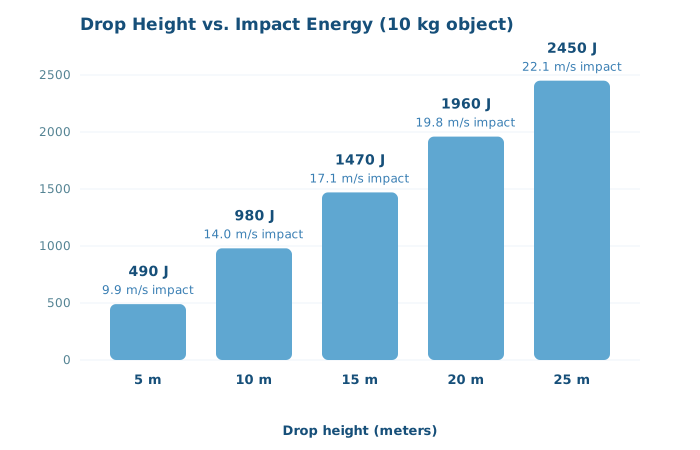
For a 10 kg object, dropping from 25 m produces the same 2,450 J of kinetic energy — and the same 22.14 m/s impact speed — as reaching that speed by any other means.
Benefits of Using an Online KE Calculator
Common Mistakes to Avoid
- Forgetting to square the velocity: The most common error in manual calculations.
- Mixing units: Mass must be in kg and velocity in m/s for the raw formula — this calculator converts other units for you automatically.
- Confusing velocity with acceleration: Kinetic energy depends only on current speed, not on how fast the object is speeding up.
- Confusing kinetic energy with momentum: They use different formulas and grow at different rates — see the comparison above.
Applications of Kinetic Energy in the Real World
- Engineering: Engineers use KE to design safer cars (crumple zones) and efficient roller coasters.
- Sports: Coaches and athletes study the KE of a pitched ball or a swinging bat to maximize performance.
- Physics education: KE is the foundation for understanding thermodynamics and the work-energy theorem.
Who Should Use This Calculator?
- High school students: Perfect for checking physics homework.
- College students: Useful for quick lab report verifications.
- Teachers: A visual aid to show how changing mass or velocity affects results.
- Engineers & hobbyists: A quick reference for energy calculations in DIY projects.
Kinetic Energy vs. Potential Energy
While kinetic energy is the energy of motion, potential energy (PE) is the energy of position or storage. Think of a bow and arrow: pulling the string back stores potential energy; releasing it converts that energy into kinetic energy as the arrow flies. Together, KE and PE make up the mechanical energy of a system.