What Is a Cash-Out Refinance?
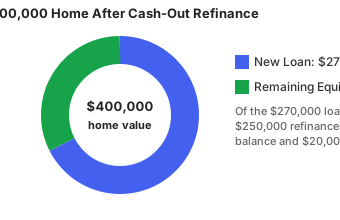
A cash-out refinance lets you replace your existing mortgage with a new, larger loan—using the difference to get cash in hand. This is possible because of the equity you've built in your home. For example, if your house is worth $400,000 and your current mortgage balance is $250,000, you may be able to refinance into a new loan of $270,000 and take out $20,000 in cash.
Our Cash-Out Refinance Calculator helps you quickly see how much equity you can tap, what your new loan will look like, and how monthly payments change. This calculator reflects U.S. mortgage market conventions — loan-to-value limits, amortization structure, and closing cost norms — since cash-out refinancing as a product is specific to how U.S. mortgages work.
Current Cash-Out Refinance Rates
Cash-out refinance rates run a bit higher than standard rate-and-term refinances, since lenders treat a larger loan balance as somewhat higher risk. As of mid-2026, the national average 30-year fixed refinance APR is around 6.9%, with cash-out refinances typically running about a quarter to half a point higher.
| Refinance Type | Typical APR (2026) |
|---|---|
| Rate-and-Term Refinance | ~6.3% – 6.9% |
| Cash-Out Refinance | ~6.5% – 7.25% |
| VA Cash-Out Refinance | ~6.25% – 6.75% (often lower, no PMI) |
Based on 2026 data from Bankrate's national lender survey. Your actual rate depends on credit score, loan-to-value, loan type, and lender — shop around rather than assuming any single published rate applies to you.
How Much Equity Can You Cash Out? (LTV Limits)
Lenders cap how much of your home's value you can borrow against, expressed as loan-to-value (LTV) ratio. This cap is what the "Max LTV" field above lets you model directly.
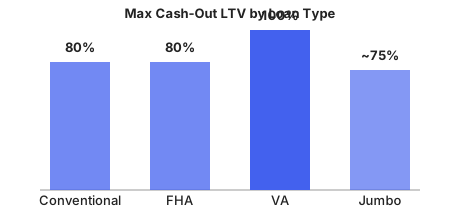
Try the interactive LTV explorer in the calculator above — drag the slider to see how different LTV caps change your available cash in real time, based on the home value and balance you've entered.
Where Is "Cash-Out Refinance" Actually Searched?
This is worth being upfront about: cash-out refinancing, as this calculator models it, is a specifically U.S. mortgage product, and search demand for the term reflects that closely.
- United States: By far the largest market for this exact term — it's tied to distinctly American mortgage features like 30-year fixed rates, conforming loan limits, and FHA/VA/conventional loan categories.
- Canada: The second most relevant market. Canadian lenders use the same "cash-out refinance" terminology and a similar 80% LTV cap, though Canadian mortgages typically renew every few years rather than locking a rate for the full term.
- UK, Australia, and most other countries: Search volume for this specific term is low, not because homeowners there can't access equity, but because the product goes by different names — "remortgaging to release equity" in the UK, for example — and mortgage structures (variable rates, different amortization norms) don't map directly onto the U.S. model this calculator uses.
- Pakistan and much of South Asia: This specific product and search term have little relevance, since home financing in these markets is structured very differently (often Shariah-compliant diminishing-musharakah financing rather than Western-style amortizing mortgages). A homeowner here looking to access property equity would be searching under entirely different terms and products.
If your audience is outside the U.S. and Canada, "home equity release," "remortgage calculator," or region-specific financing terms are likely to match actual search intent better than "cash-out refinance."
Key Factors in the Calculator
- Home Value – Your property's current market value.
- Current Mortgage Balance – What you still owe on your home.
- Desired Cash-Out – The amount of equity you'd like to access.
- Max LTV (Loan-to-Value) – The percentage of your home's value a lender allows you to borrow (often capped at 80%, up to 100% for VA loans).
- New Interest Rate – The APR you'll pay on your refinanced loan.
- Loan Term – The length of your new mortgage (e.g., 15 or 30 years).
- Closing Costs – Fees associated with refinancing, typically 2–6% of the loan, which may be rolled into the loan.
With these details, the calculator instantly shows your new loan amount, estimated monthly payment, and total interest over time.
Why Use a Cash-Out Refinance Calculator?
- See Real Numbers – Don't rely on rough estimates. Know exactly how much cash you can take out and what your new payments will be.
- Compare Scenarios – Test different interest rates, loan terms, or cash-out amounts to see which option works best for your finances.
- Understand Costs – View the impact of closing costs, monthly payment changes, and total interest paid over the loan's life.
- Plan with Confidence – Walk into lender meetings knowing your numbers, so you're less likely to be surprised by hidden costs or unrealistic offers.
How Does the Calculator Work?
The calculator uses your home's value, remaining mortgage balance, and refinance details to estimate your new loan. It applies amortization formulas to show monthly payments and breaks down interest versus principal.
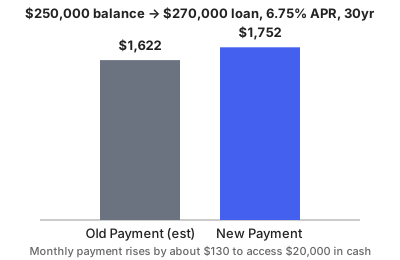
For example, if your home is valued at $400,000 with a $250,000 balance and you want $20,000 cash out at a 6.75% APR for 30 years, the calculator will display:
- Base loan (your balance to be refinanced)
- Cash-out amount you'll receive
- New loan amount
- New monthly payment
- Total interest over the loan term
Cash-Out Refinance vs. HELOC vs. Home Equity Loan
| Cash-Out Refinance | HELOC | Home Equity Loan | |
|---|---|---|---|
| Structure | Replaces your entire mortgage with one new, larger loan | A revolving credit line on top of your existing mortgage | A separate fixed loan on top of your existing mortgage |
| Rate type | Usually fixed | Usually variable | Usually fixed |
| Your existing rate | Replaced — you lose a low rate if you have one | Untouched | Untouched |
| Closing costs | 2–6% of the new loan | Often lower, sometimes minimal | Typically 2–5% of the loan |
| Best when | Today's rates are near or below your current rate | You want flexible, as-needed access to funds | You want a fixed lump sum without touching your first mortgage |
If your current mortgage rate is well below today's market rate, a HELOC or home equity loan often makes more sense than a cash-out refinance — refinancing would mean giving up your existing low rate on the entire balance, not just the new cash.
How to Use Our Cash-Out Refinance Calculator
- Enter your home's current market value.
- Type in your remaining mortgage balance.
- Add your desired cash-out amount (or a maximum LTV percentage).
- Enter the new interest rate and loan term you're considering.
- Include closing costs if applicable.
- Click Calculate to view results instantly.
You'll see side-by-side comparisons of old versus new payments, plus visual charts showing the share of principal vs. interest.
When Does a Cash-Out Refinance Make Sense?
- Home Improvements – Fund renovations that can boost property value.
- Debt Consolidation – Replace high-interest debt (like credit cards) with a lower-interest mortgage loan.
- Major Expenses – Cover tuition, medical bills, or other big costs.
- Better Interest Rates – Refinance if today's rates are lower than your current mortgage rate.
Important Considerations
While cash-out refinancing can be beneficial, it's not for everyone. Taking equity out reduces the ownership stake in your home and may increase your total interest if you extend the loan term or reset a 15-year loan back to 30 years. Closing costs of 2–6% apply just as they did on your original mortgage. Always compare costs and future risks before making a decision, and consider getting quotes from multiple lenders since rates and fees vary.
Frequently Asked Questions
What is a Cash-Out Refinance Calculator?
A Cash-Out Refinance Calculator is an online tool that helps homeowners estimate how much cash they can take out by refinancing their mortgage, along with the new monthly payment and total loan costs.
How do I use the Cash-Out Refinance Calculator?
Enter your home value, current mortgage balance, desired cash-out amount (or a max LTV), new interest rate, and loan term. The calculator estimates your new loan amount, monthly payment, and total interest.
Why should I use a Cash-Out Refinance Calculator?
It helps you understand how much equity you can access, compare refinancing scenarios, and see the real impact on your monthly budget before talking to a lender.
Can I use the calculator for investment properties?
Yes, the math works the same way, but lenders typically apply lower max LTV limits and higher rates for second homes and investment properties than for a primary residence.
What's the maximum I can cash out?
It depends on your loan type's LTV limit — commonly 80% of home value for conventional and FHA loans, and up to 100% for VA loans. Enter a Max LTV above to see your estimated limit directly.
Is a cash-out refinance better than a HELOC?
It depends on your current mortgage rate. If today's rates are near or below what you're already paying, a cash-out refinance can make sense. If your existing rate is much lower than current rates, a HELOC or home equity loan avoids resetting your whole mortgage to a higher rate.
Is the Cash-Out Refinance Calculator free?
Yes, our Cash-Out Refinance Calculator is completely free to use and works on desktop and mobile devices.
Final Thoughts
A Cash-Out Refinance Calculator is the easiest way to see how much money you can access and how it will affect your mortgage. Whether you're paying off debt, funding a remodel, or just exploring options, our calculator gives you the clarity you need.
👉 Try it now and take control of your home equity with confidence.